Discovering ‘The Most Žiri’ Things

The town of Žiri, located 28km from Škofja Loka between the basins of the Sora and Idrijca rivers, is known, above all, for its long history of shoemaking and bobbin lacemaking, as well as its unspoilt idyllic location.

On the sunny spring Sunday when I visited, Žiri was about as scenic and tranquil as it gets, and I found myself wondering why on earth I hadn’t been there before!

Granted, it’s not exactly ‘on the way’ to anywhere, thus it has always been slightly off my radar, but at the same time its location at the meeting point of 3 of Slovenia’s regions – Gorenjska, Notranjska, Primorska – makes it actually easily accessible and, from what I’ve seen of it so far (I fully intend to go back!), it’s definitely somewhere that should be on my, and your, radar!

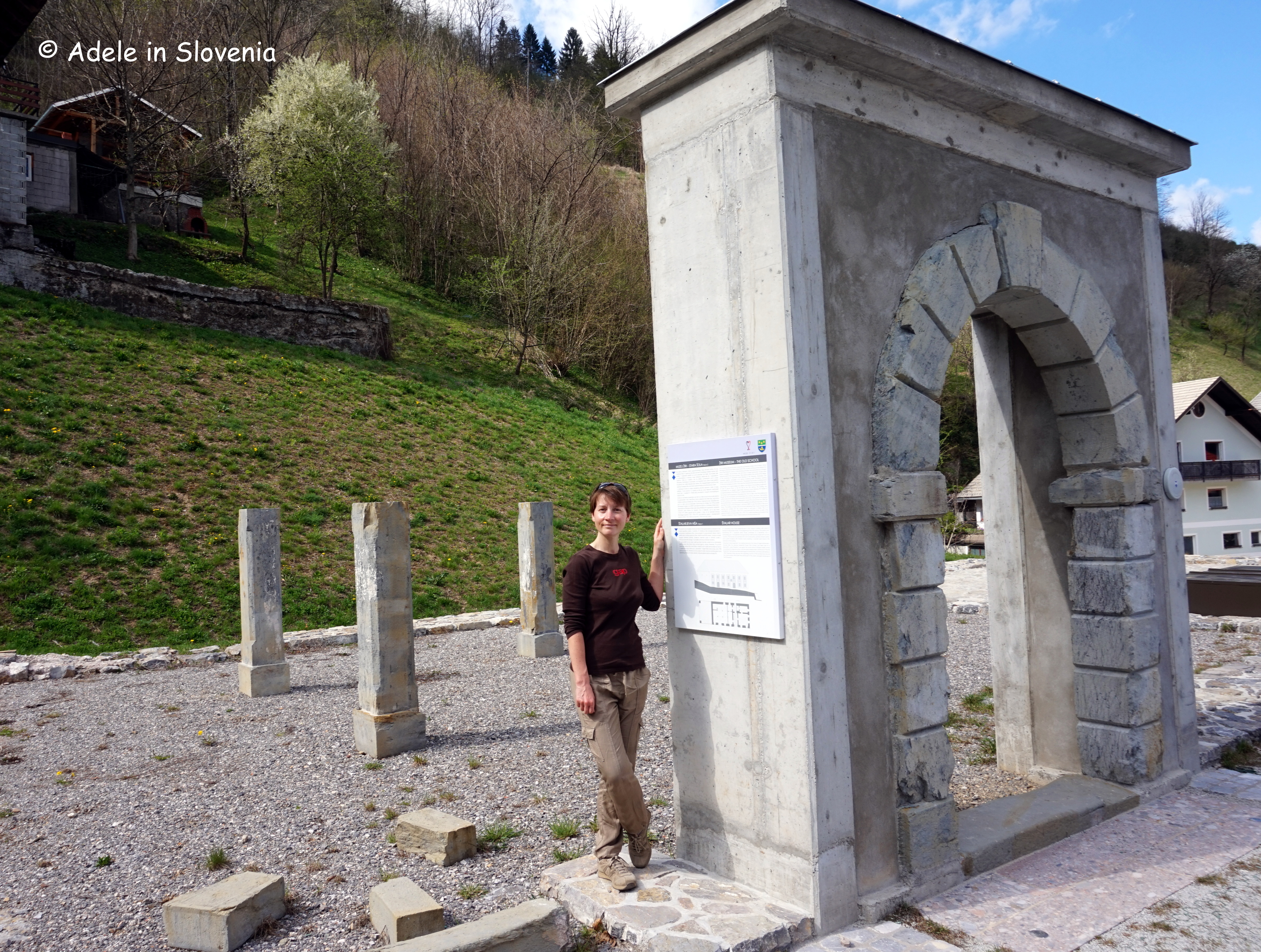
The best place to start to find out more about the town is at Žiri Museum, which since 1970 has been housed in the old school and former lace school, considered one of the town’s most beautiful buildings. The museum has collections dedicated to the history of the town and its surroundings as well as its main economic activities – agriculture, bobbin lacemaking and shoemaking.

Before even setting foot in the museum there are exhibits to see, including fortifications of the former Rapallo border.
The entire area used to be a lake and you can find out more about that through the museum’s exponents and exhibitions titled ‘Žiri and its People Through Time’, ‘Žiri’s Painters’ and ‘Welcome, Fortress Lovers’.
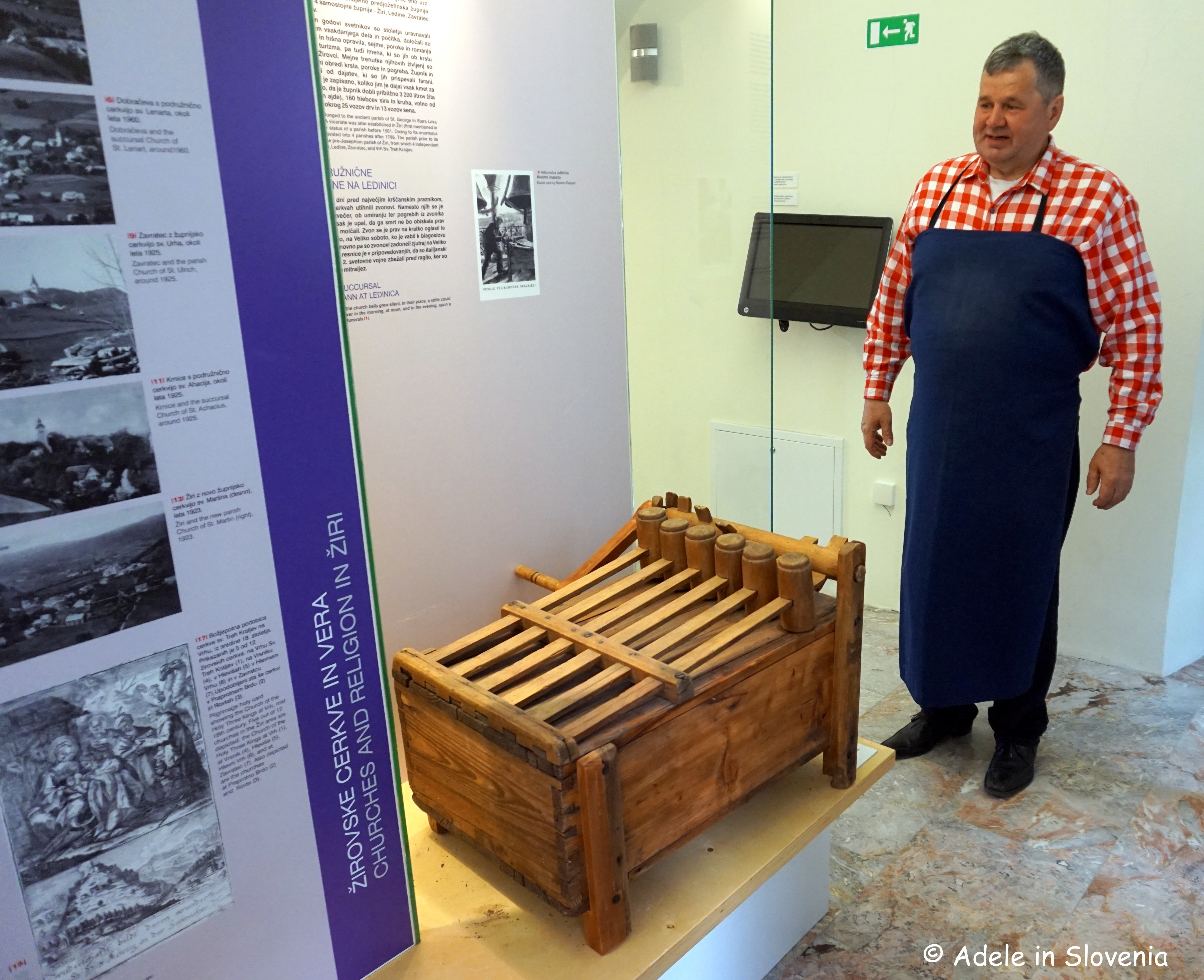
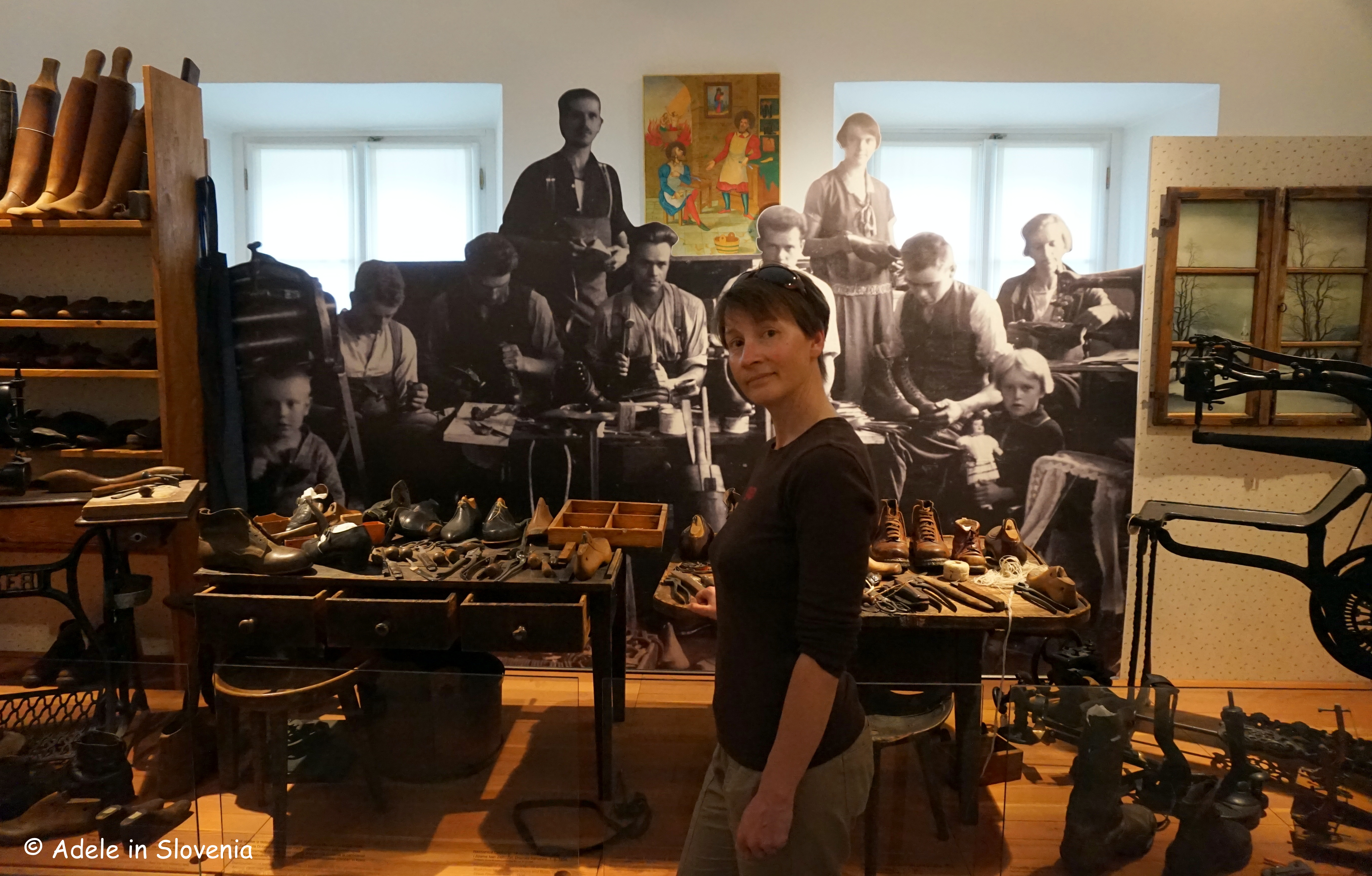
Another exhibition is ‘Shoemaking in Žiri’ – the town is home to the Alpina footwear factory. The craft began to develop in the town towards the end of the 19th century and although the ‘golden age’ of shoemaking in Žiri has been and gone – the majority of the shoemaking shops have closed – the Alpina factory is still going strong. There are around 30 Alpina shops throughout Slovenia and their footwear is used by many top sportsmen and women.

The other craft for which Žiri is known is bobbin lacemaking – it is one of the three centres of bobbin lacemaking in Slovenia. One of the highlights of the calendar year is Lacemaking Days (Klekljarski dnevi), which this year takes place from 27th April to 2nd May. The Cvetke Žiri Bobbin Lacemaking Association prepares exhibitions, workshops and competitions, and a chance for all generations to get an insight into this skilled craft. During the festival, the nearby Alpina factory also opens its doors and offers visitors footwear at bargain prices.

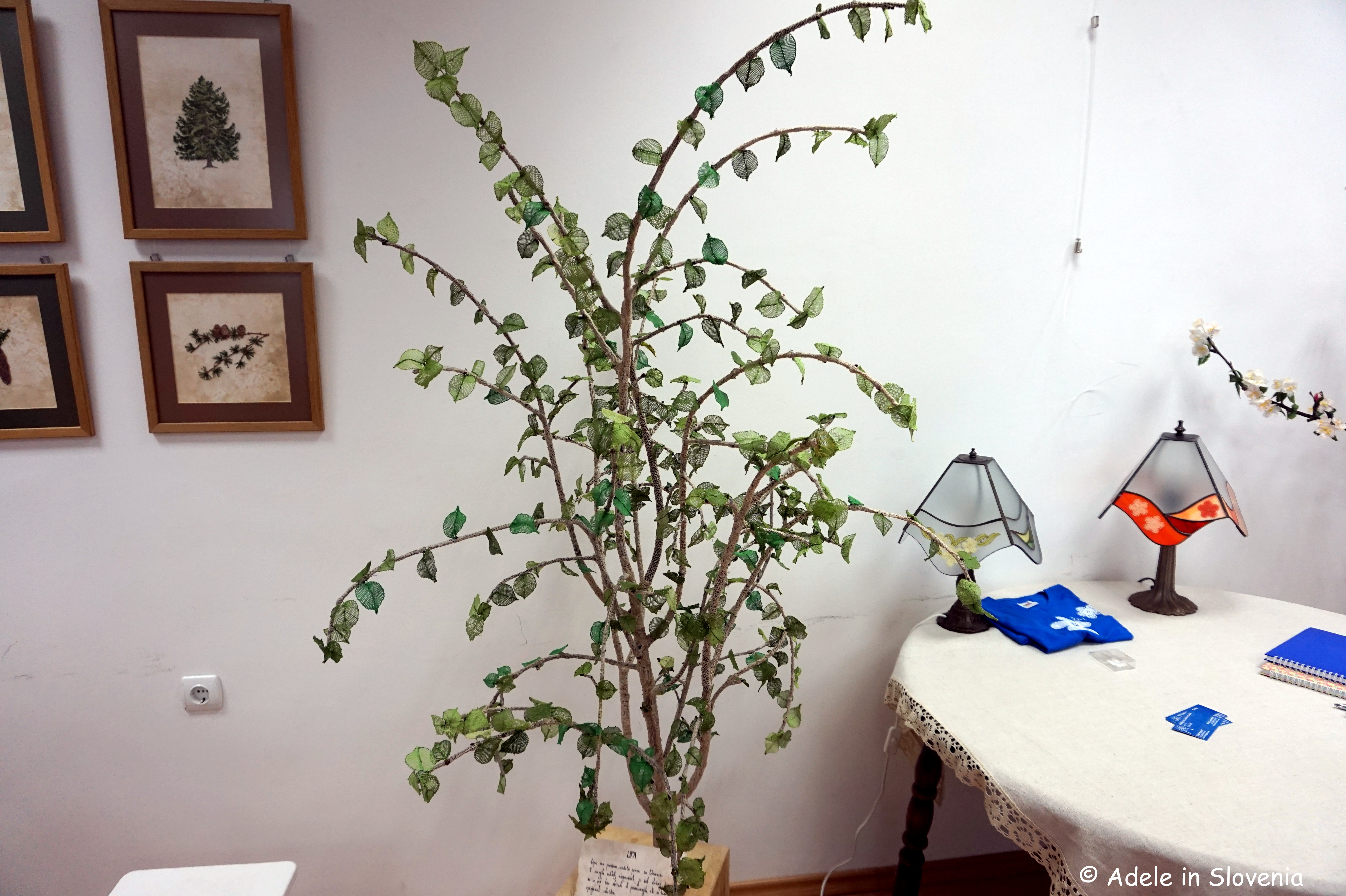
One of the exhibitions at this year’s festival is ‘Trees in Lace’, prepared in collaboration with the Slovenian Forestry Institute. The exhibition comprises 12 tree species and their fruits, blossoms and leaves. Getting up close to the pictures, you can really see just how much work went into creating these intricate trees made entirely out of lace – each tree took 100-200 hours to make – and the exhibition has received an exceptional reaction wherever it has been displayed since it was opened in 2011 to mark the 70th anniversary of the institute.

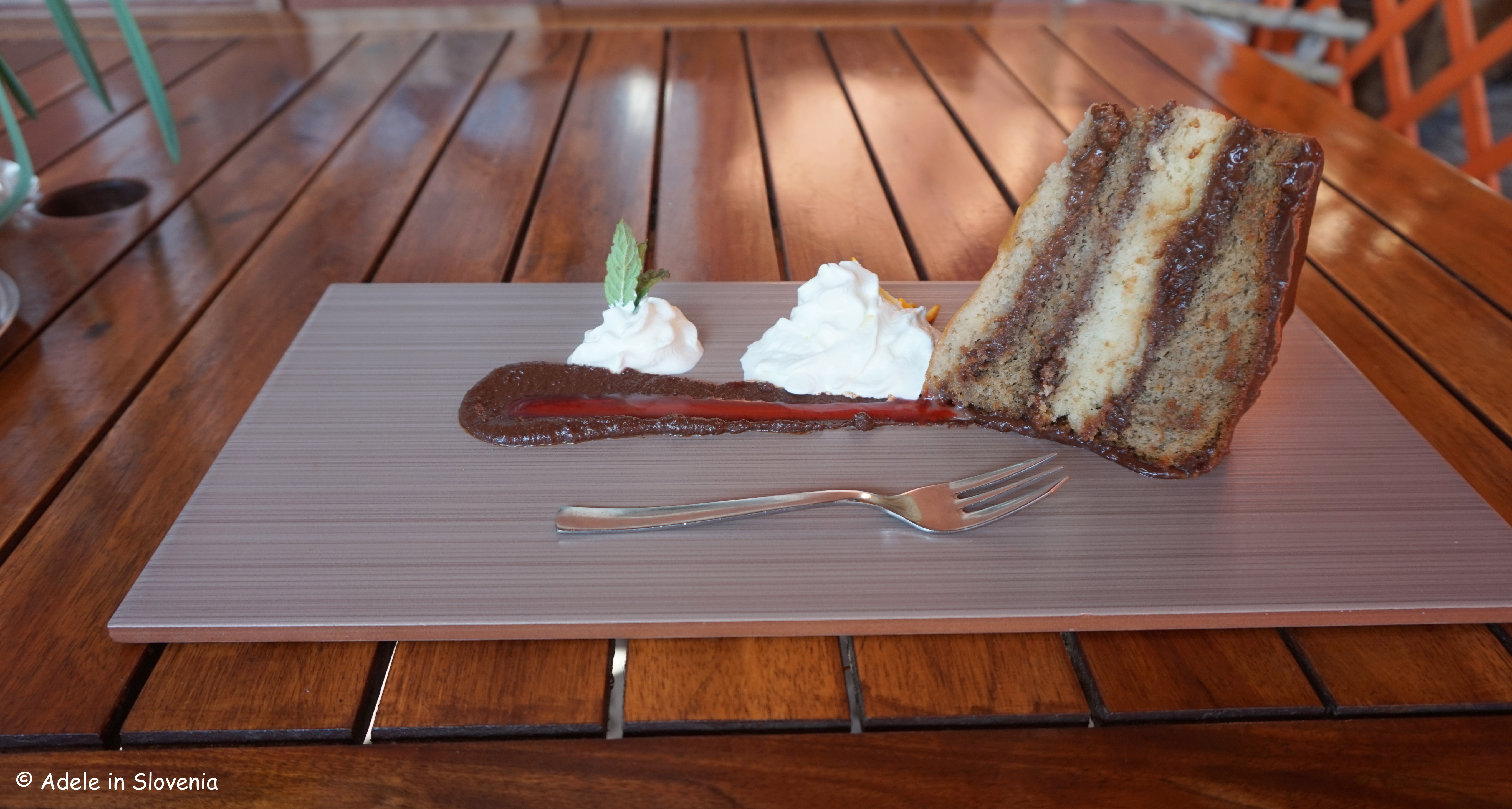
There are a handful of bars and restaurants in Žiri, among the most known and popular is the family-run Gostilna Župan. I’d had an insider tip that their house cake – Županova torta – is the bee’s knees, so, well…. it would be rude not to! The restaurant also has a full menu of traditional Slovene dishes.
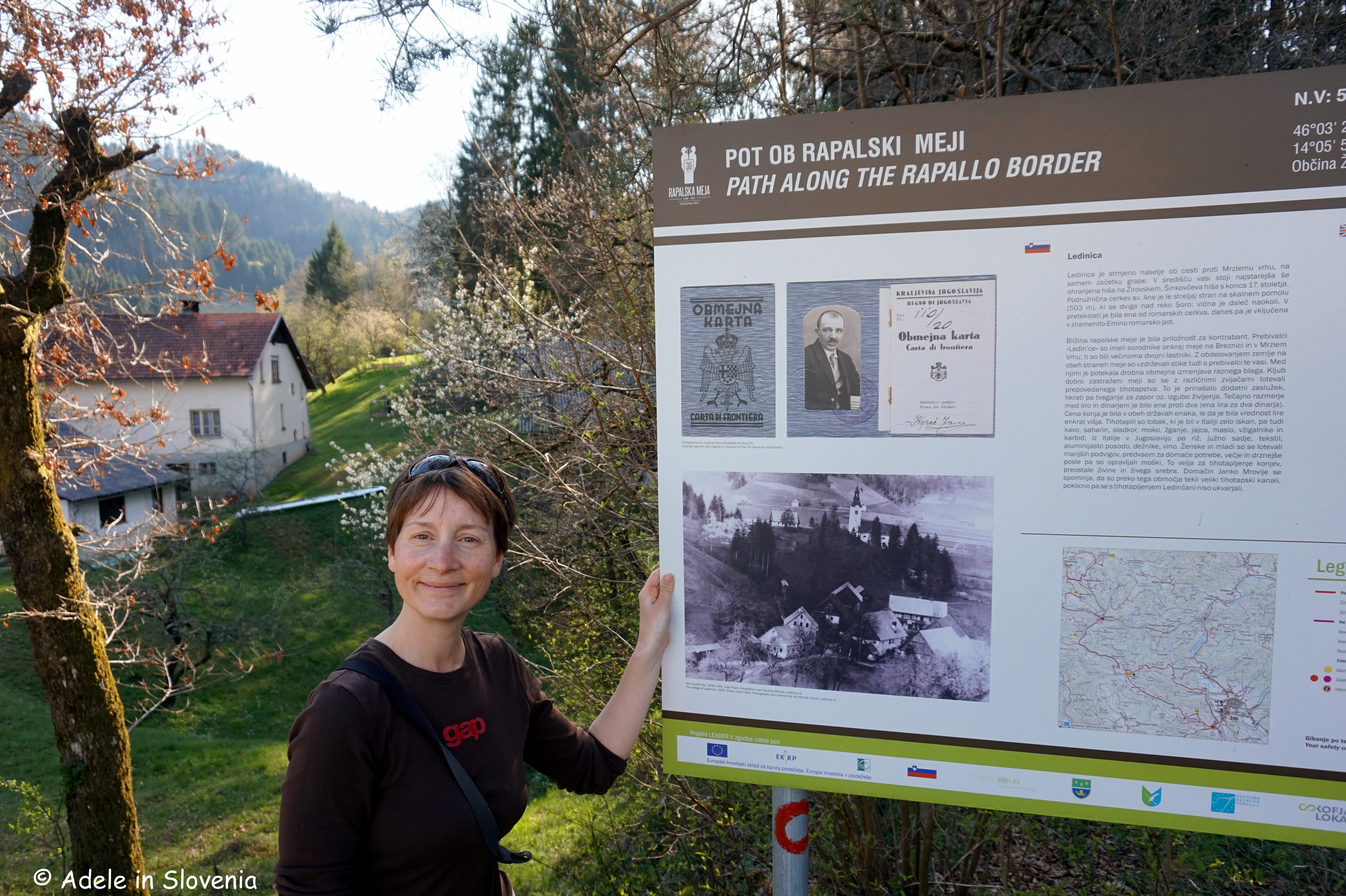
To walk off some of that cake, I took a wander on the scenic Path by the Sora river (Pot ob Sori) and along a short part of the Path Along the Rapallo Border, part of which runs along the hilltop ridges above the town.

Žiri Museum is open on Sundays from 3pm and 6pm, and at other times by prior arrangement – http://muzej-ziri.si/ (website in Slovene only).

For more information about Žiri or to arrange custom-designed excursions of the area, see the Visit Škofja Loka website http://www.visitskofjaloka.si/en/skofja-loka-area/ziri. The Visit Škofja Loka Facebook page has regular updates about events and activities in the area – https://www.facebook.com/skofjaloka/?fref=ts

© Adele in Slovenia
 

Archery Adventures and Delicious Draga Delights!

The beautiful Draga valley in Begunje in Gorenjskem – home to the ruins of Kamen Castle, the Gostišče Draga restaurant and the start point for numerous hikes in the Karavanke mountains – has just got even better thanks to the new improved 28-target archery range.

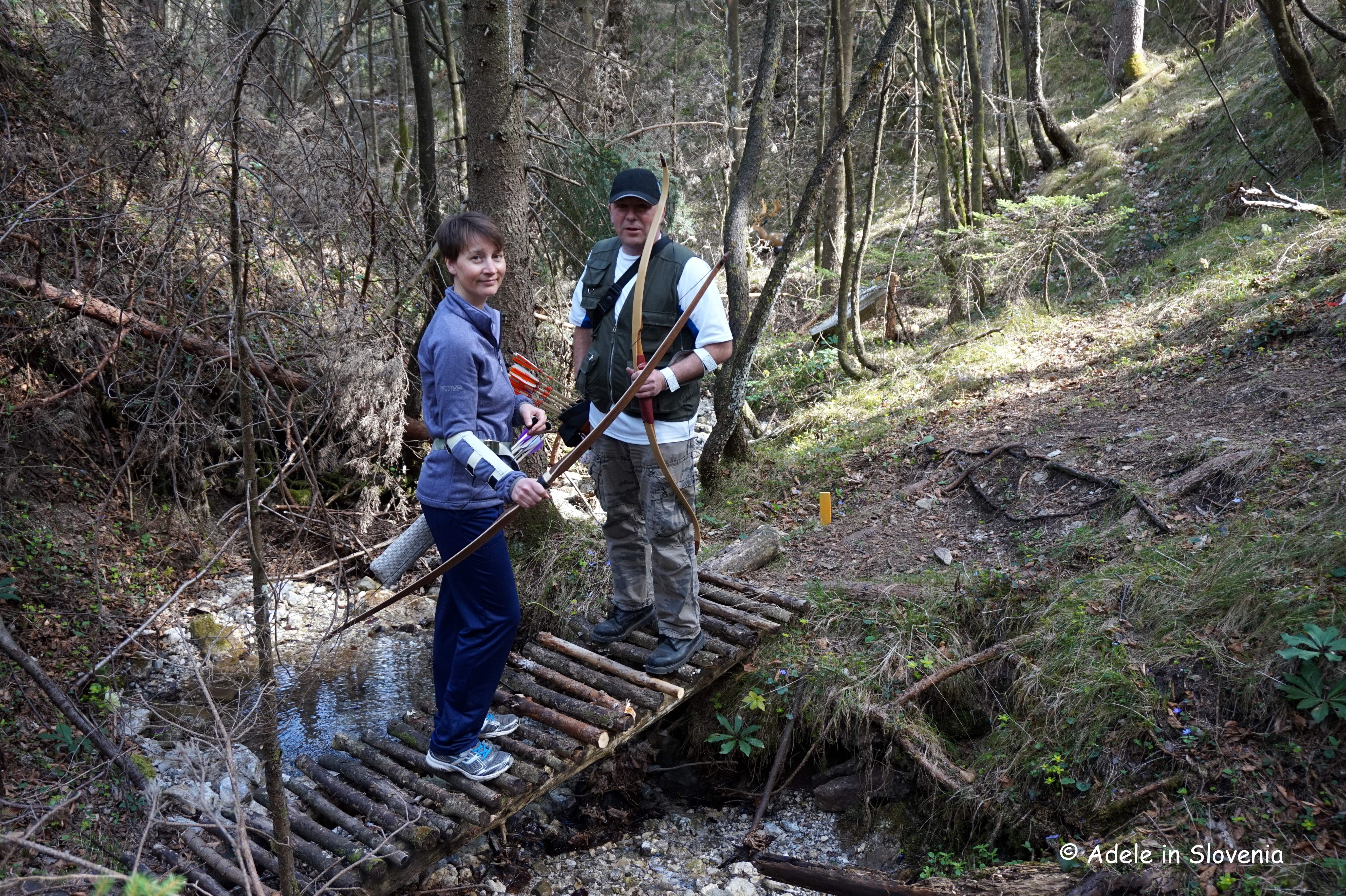
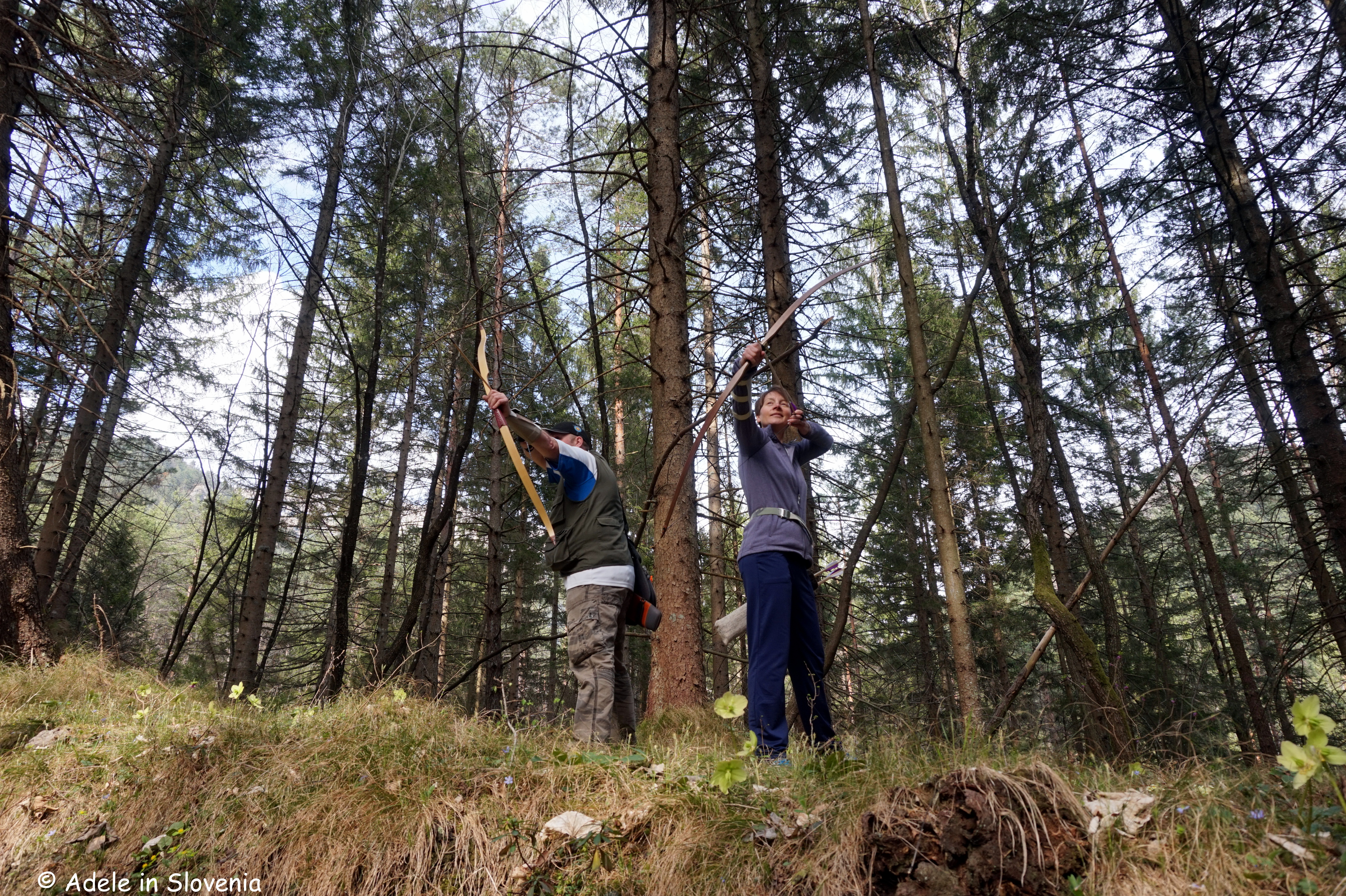
Having never so much as held a bow and arrow, I was keen to try it out for myself and, I must say, I’m hooked already and can’t wait to try it again!

If you have your own equipment, you can just turn up and pay in the Gostišče Draga restaurant and then head off on your own, of course taking care to follow the numbered markers in the correct direction.

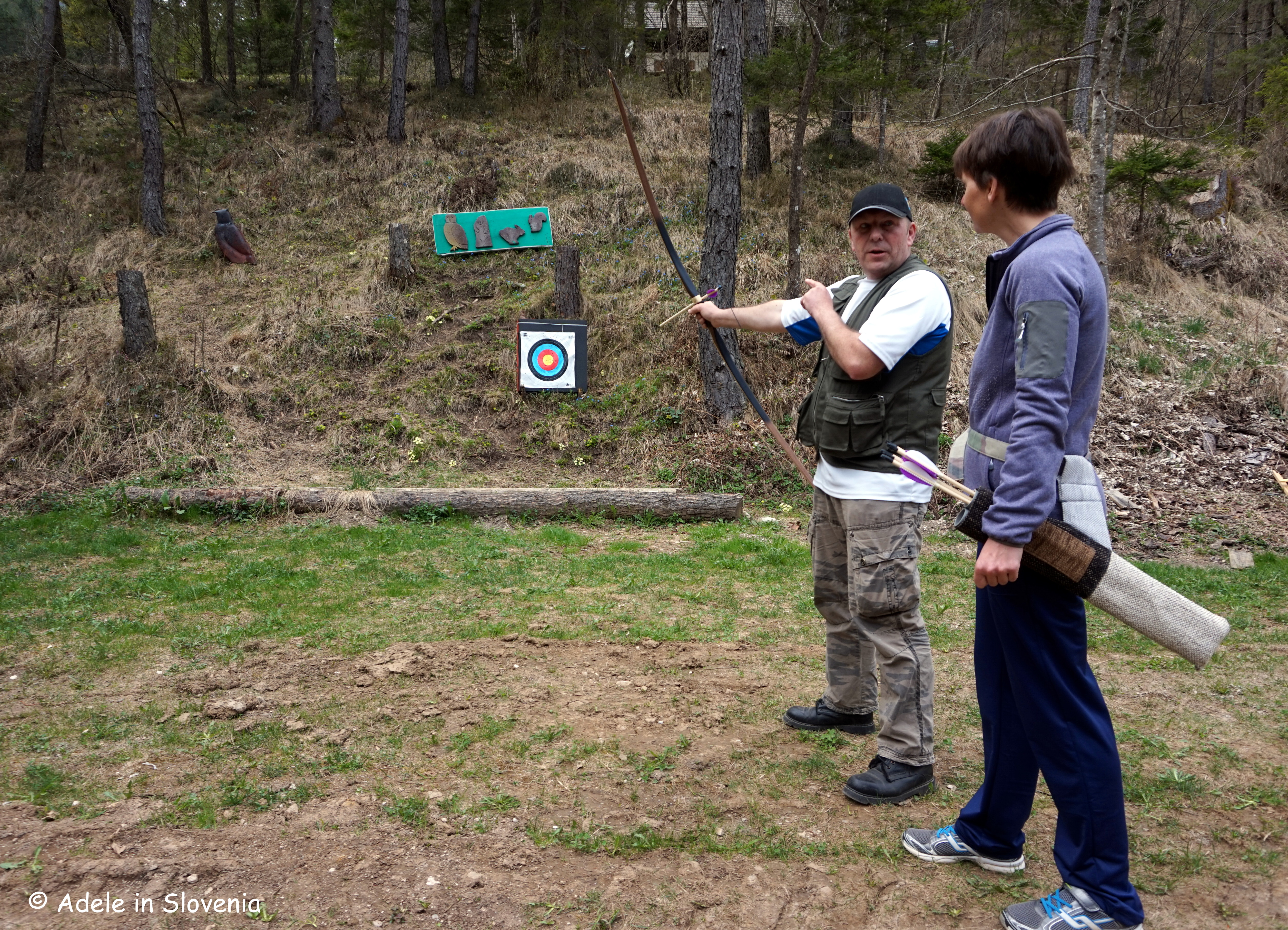
If you, like me, are a total novice or a relative newcomer to archery, or you skills are a bit rusty, then I suggest contacting the ‘go-to’ man for archery around here, Robert (Robi) Levstek.

We started with a brief safety introduction and a few warm-up shots as Robi demonstrated and talked me through the technique.

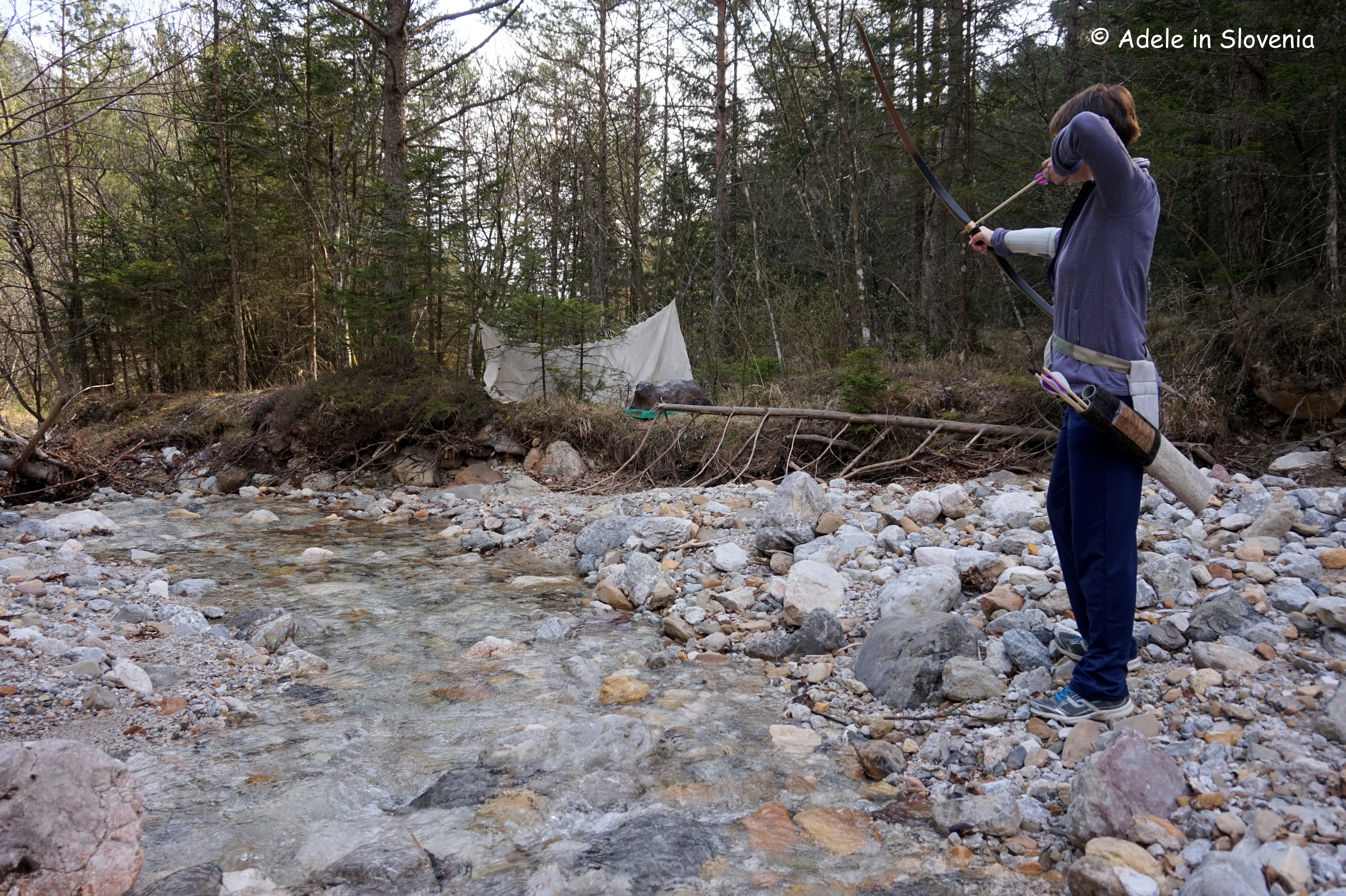
I know you probably won’t believe me, since I barely believed it myself, but this was one of my first shots – totally a case of beginner’s luck, though, as it didn’t continue in that vein!

Robi made all of the animal targets and also makes all his own bows and arrows, something he is deservedly proud of.

The archery course is also ideal for families with children, and Robi teaches children from age 3+. It’s also extremely good value, considering it provides several hours of entertainment, at just 10 euros for adults and 8 euros for children.

Sensible footwear is a must, as is comfortable clothing, but other than that all you need is a sense of adventure and good spirits!

It’s great fun making your way around the course through the forest, crossing the stream and trying to spot the life-like animals. Those with a competitive nature, and even those without, will love it. For those who want to get competitive, you can tot-up points, join the club and/or compete in the regular Parkur tournaments, whilst for others it can merely be a fun day out surrounded by the wonderful nature of the Draga valley.

The archery range is open year-round and even in winter, provided the snow cover is not too deep, you can spot the animal targets!

And no visit to the Draga valley is complete without a meal at the Gostišče Draga restaurant. Known for its fresh trout, venison, and other traditional Slovenian dishes, of late the restaurant has also become a mecca for lovers of all kinds of štruklji – sweet and savoury. Unable to decide on which to try this time, I went for the triple whammy and tried 3 different versions – buckwheat with wild garlic, classic curd cheese, and blueberry – all of which were so delicious I took some home for the next day (or two) too!


You can contact Robi and/or find out more information via the Facebook pages Parkur Draga https://www.facebook.com/parkurdraga/ and Lokostrelstvo Robert Levstek https://www.facebook.com/Lokostrelstvo-Robert-Levstek-sp-679804982054234/

Enquiries and reservations for the archery range can also be made at the Gostišče Draga restaurant – http://www.gostisce-draga.si/

But watch out, you might, like me, get hooked – on both the archery and the štruklji!

© Adele in Slovenia
The UNESCO-Listed Škofja Loka Passion Play

When UNESCO deems something important enough to be included in its List of Intangible Cultural Heritage of Humanity, you know it’s something of great value and importance, as is the case with the Škofja Loka Passion Play.

Staging of the play is based on the oldest preserved text in Slovenian language, written by Father Romuald, a Capuchin monk who lived for a time in the monastery in Škofja Loka.

Staging of the Passion Play, Photo: Andrej Tarfila Photography

Where better, then, to start my journey of discovery of the Passion Play, than with a look around St. Anne’s Church and the Capuchin Monastery – where the original manuscript is preserved – in the heart of the medieval old town of Škofja Loka.

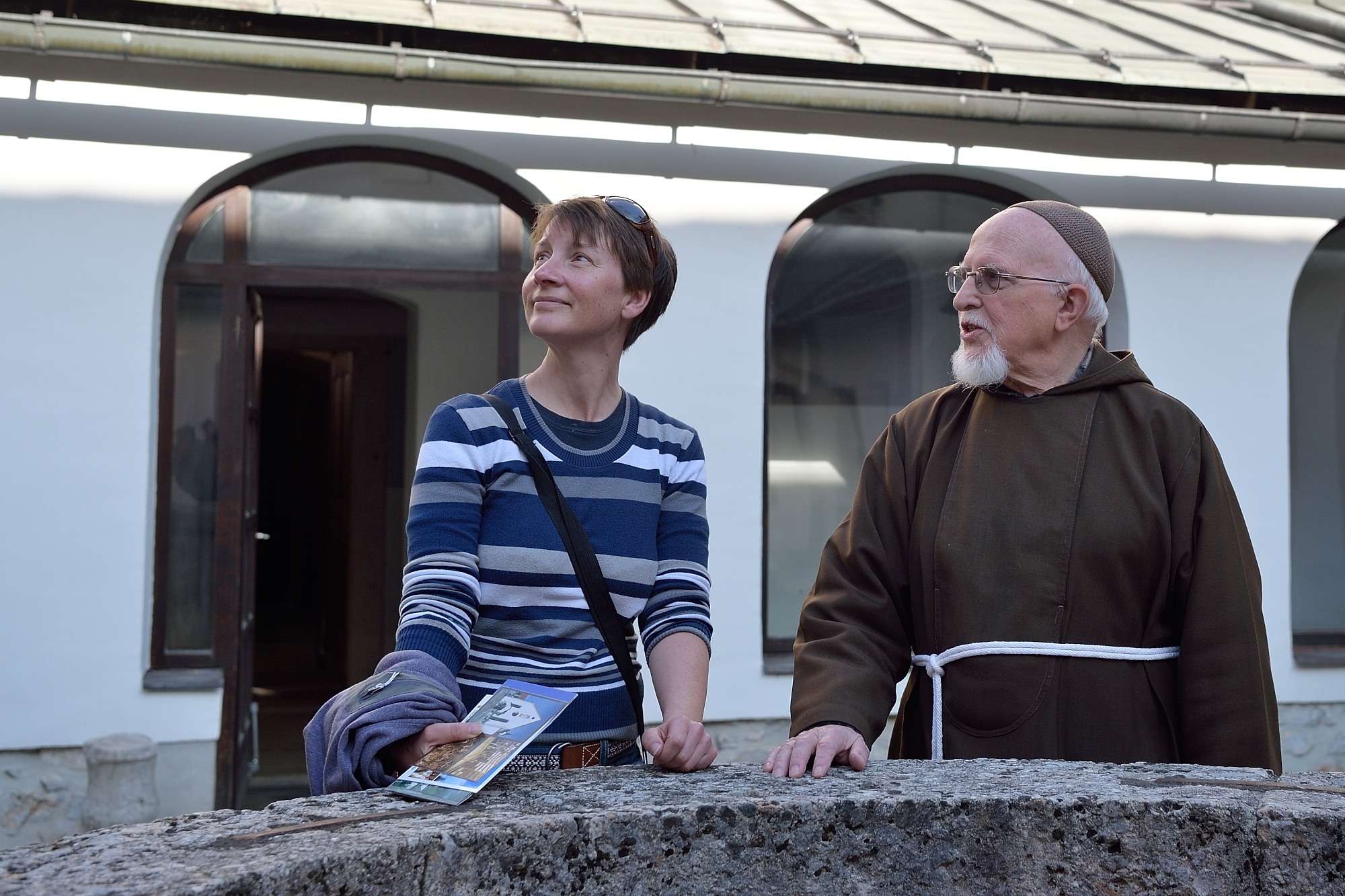
I was greeted by the sprightly 80-year monk Father Bernard who is a good testament to the benefits of clean living. It was a pleasure and a privilege to get an insight into life in the monastery and hear some of this tales of the various Capuchin monasteries where he has lived in Slovenia.

The church and monastery date back to 1707 when the foundation stone was laid, with regular church services beginning on New Year’s Day 1710.

Photo: Tomaž Sedej

Photo: Tomaž Sedej

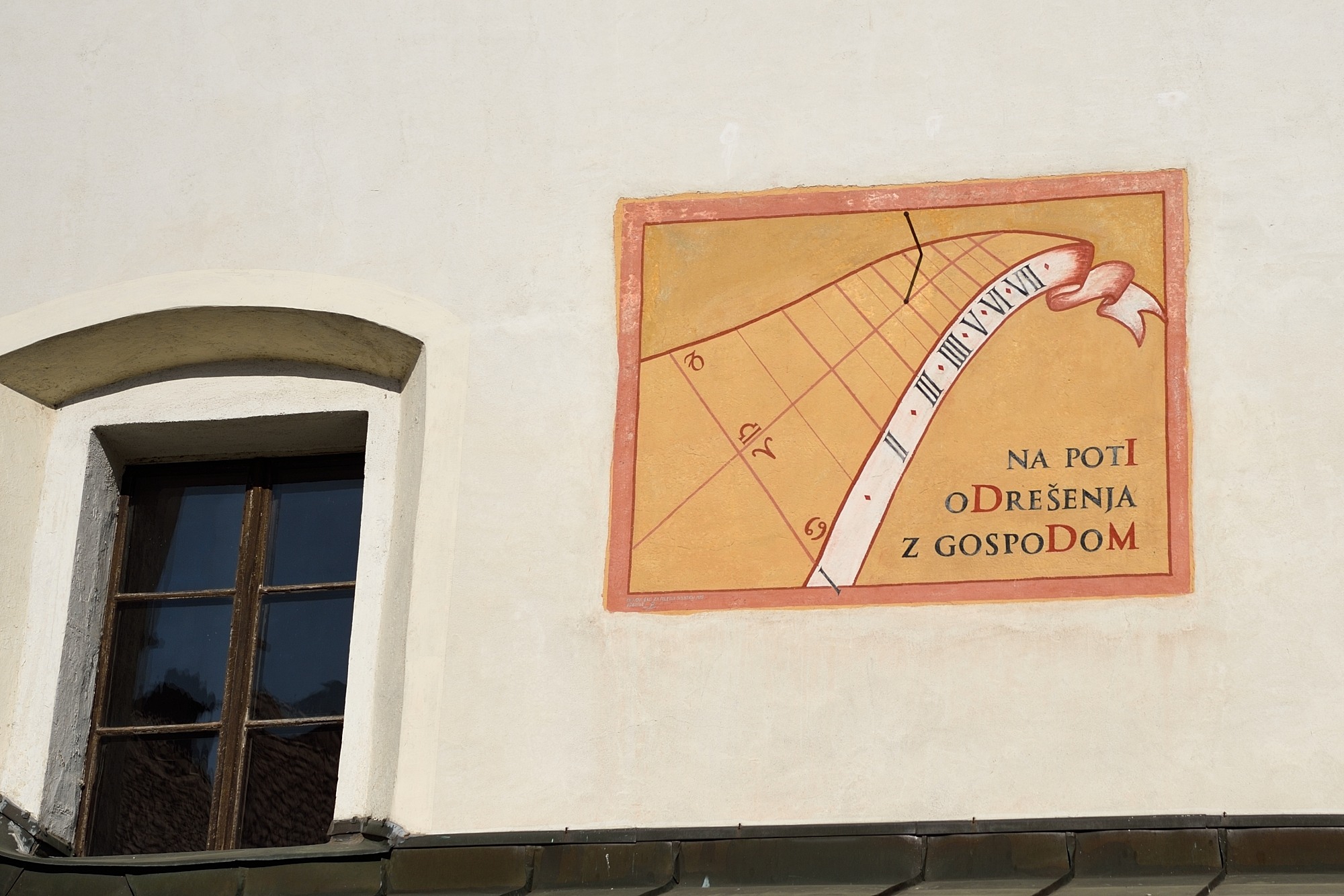
Father Bernard first showed me around the monastery’s gardens and courtyard and was particularly keen to point out the two sundials.

Photo: Tomaž Sedej

We moved on to look at the monastery church. Its layout is simple – a single nave with three chapels – however the fittings, altars and paintings are opulent. Mass takes place twice daily on weekdays at 6am and 8am, and three-times per day on Sundays and public holidays, at 8am, 11am and 6pm (at 5pm during winter) and is open to everyone.

Photo: Tomaž Sedej

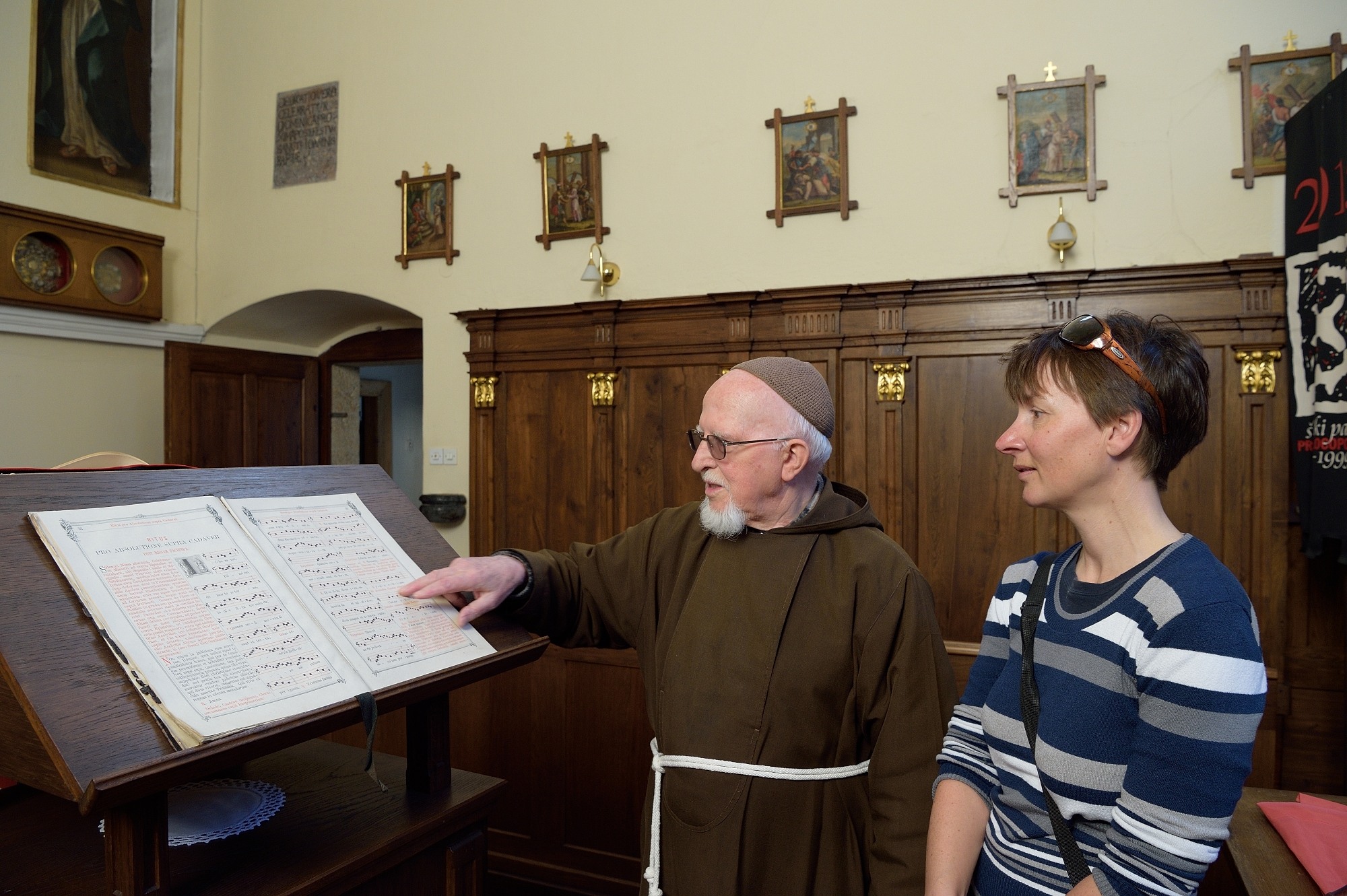
The pride and joy of the monastery, however, is undoubtedly the library on the first floor which contains 25,000 items, among them are 21 incunabula – books printed before 1501, the oldest of which dates from 1473, and the original manuscript of the Škofja Loka Passion.

The precious original manuscript. Photo: Tomaž Sedej

The library in itself is a work of art, featuring intricate hand-carving work by the acclaimed local carver Petra Podlogar Plestenjak. I met Petra and witnessed her work up close earlier this year when she taught me how to make Loka honey breads using her hand-carved moulds at the DUO Arts and Crafts Centre. Read more here – https://adeleinslovenia.com/?s=Loka+honey+breads

Carving by Petra Plestenjak Podlogar, Photo: Kati Sekirnik

Conditions in the library are maintained at a constant level of light and humidity to ensure preservation of the centuries-old precious books. I was almost afraid to breathe, such are the pristine conditions of the books in the library and the sense of history they convey.

There is also a separate exhibition area which includes copper reliefs of scenes from the Passion Play, and historical photos of the Capuchin monasteries in Slovenia.

Copper reliefs of scenes from the Passion, Photo: Tomaž Sedej

The Passion Play was originally performed on Good Friday each year until 1751. Almost 300 years later it was again held in 1936, before being revived in 1999. The play is now staged every 6 years, with the last full performance being held in 2015. So, we may have to wait until 2021 for the next performance, but, as they say “All the best things are worth waiting for!”

Around 800 people, including actors, volunteers, dressmakers etc., are involved in the staging of the largest open-air theatre production in Slovenia (and surely further afield too).

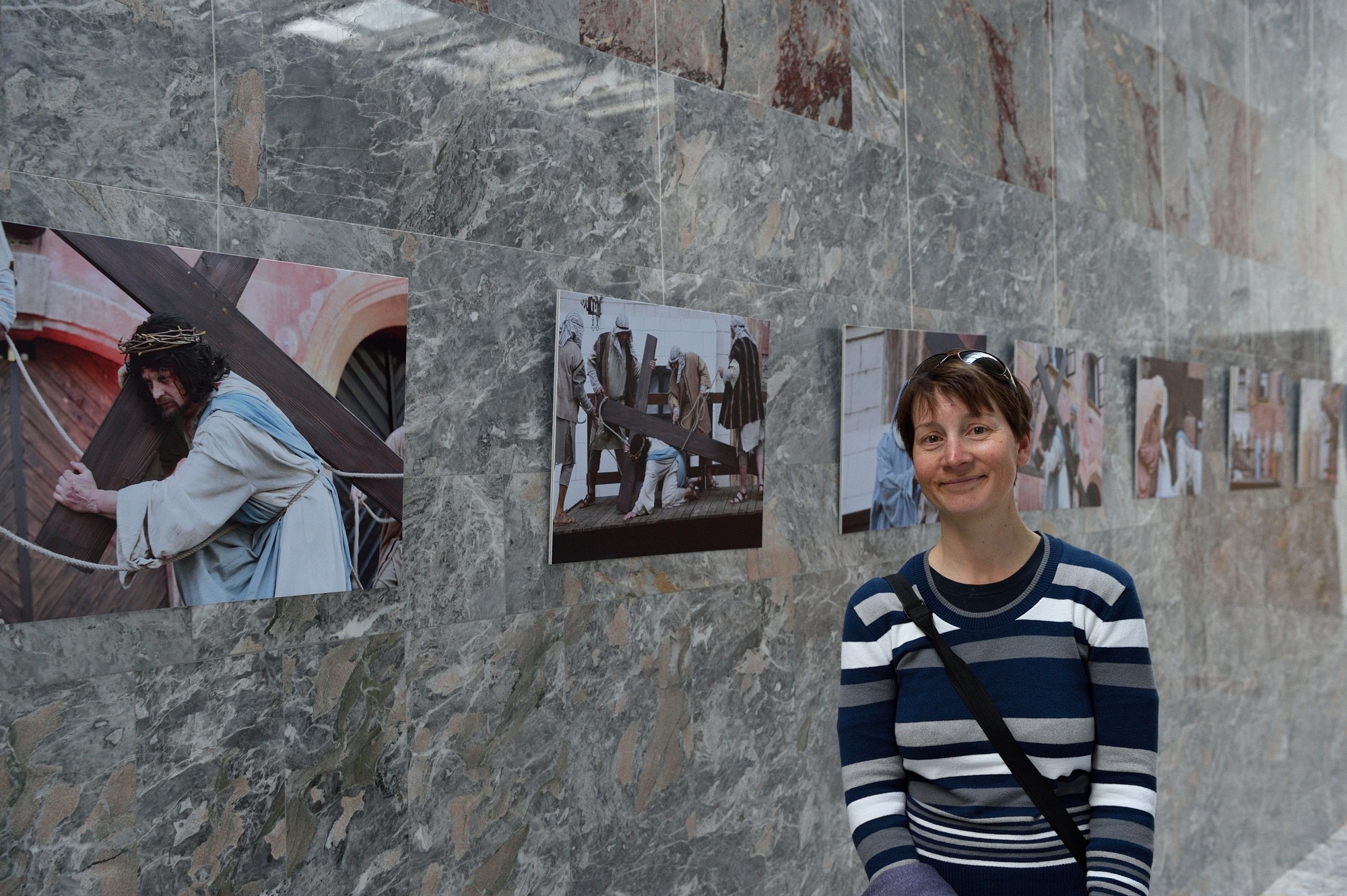
There is currently an exhibition of pictures of the Passion Play on view in the Sokolski dom building in the centre of Škofja Loka’s old town. The exhibition by Jože Štukelj is based on the UNESCO session in Addis Ababa, Ethiopia, held from 27.11-2.12.2016, where the Passion Play was officially inscribed into the afore-mentioned UNESCO List. Entry to the exhibition is free and it is open until 17th April.

The current exhibition in Sokolski Dom, Photo: Tomaž Sedej

More information about the Škofja Loka Passion Play can be found here – http://www.pasijon.si/en/ and about the Capuchin Library on the Visit Škofja Loka website here – http://www.visitskofjaloka.si/en/experiences/culture-and-art

2021 will come around before you know it, so mark the date now!

© Adele in Slovenia

Slovenia’s Historic Towns and Cities

Statistics show that the large majority of people who visit Slovenia tend to do so for just a few days, either as just a mini-break or as part of a longer trip taking in some of the neighbouring countries. And for those limited in time, the focus is usually on the ‘usual’ tourist hot-spots i.e. Bled Lake, Ljubljana, Postojna Caves, Piran... However, in visiting just these, admittedly marvellous, places, you miss – in my opinion – a large swathe of the country and the chance to see the ‘real’ Slovenia.

Granted, I might be a bit biased since I’m fortunate to live in Radovljica, which has one of Slovenia’s best-preserved medieval old town centres and is a member of the Association of Historical Towns and Cities of Slovenia, but since Slovenia is a perfectly compact country, it is very easy to get around and make detours to other places of interest. So, sure, go to the usual tourist hotspots to tick them off the list, but do take time to see more of Slovenia’s countryside, culture and history too!

Looking over Radovljica and beyond to the Karavanke mountains

For example, if you are visiting Bled, then turn off the motorway (or get off the train or bus) just one stop early, and within minutes you will be in the historic old town centre of Radovljica where you can see, amongst others, the frescoed townhouses, the Baroque St. Peter’s Church, and the Šivec House Gallery.

Vidic House, just one of the frescoed buildings in the old town

The Radovljica Mansion is home to the Museum of Apiculture, the Municipal Museum, and a music school. During daylight hours the building is always open and visitors are welcome to go in and look at the photographic exhibitions in the entrance foyer.

The Radovljica Mansion

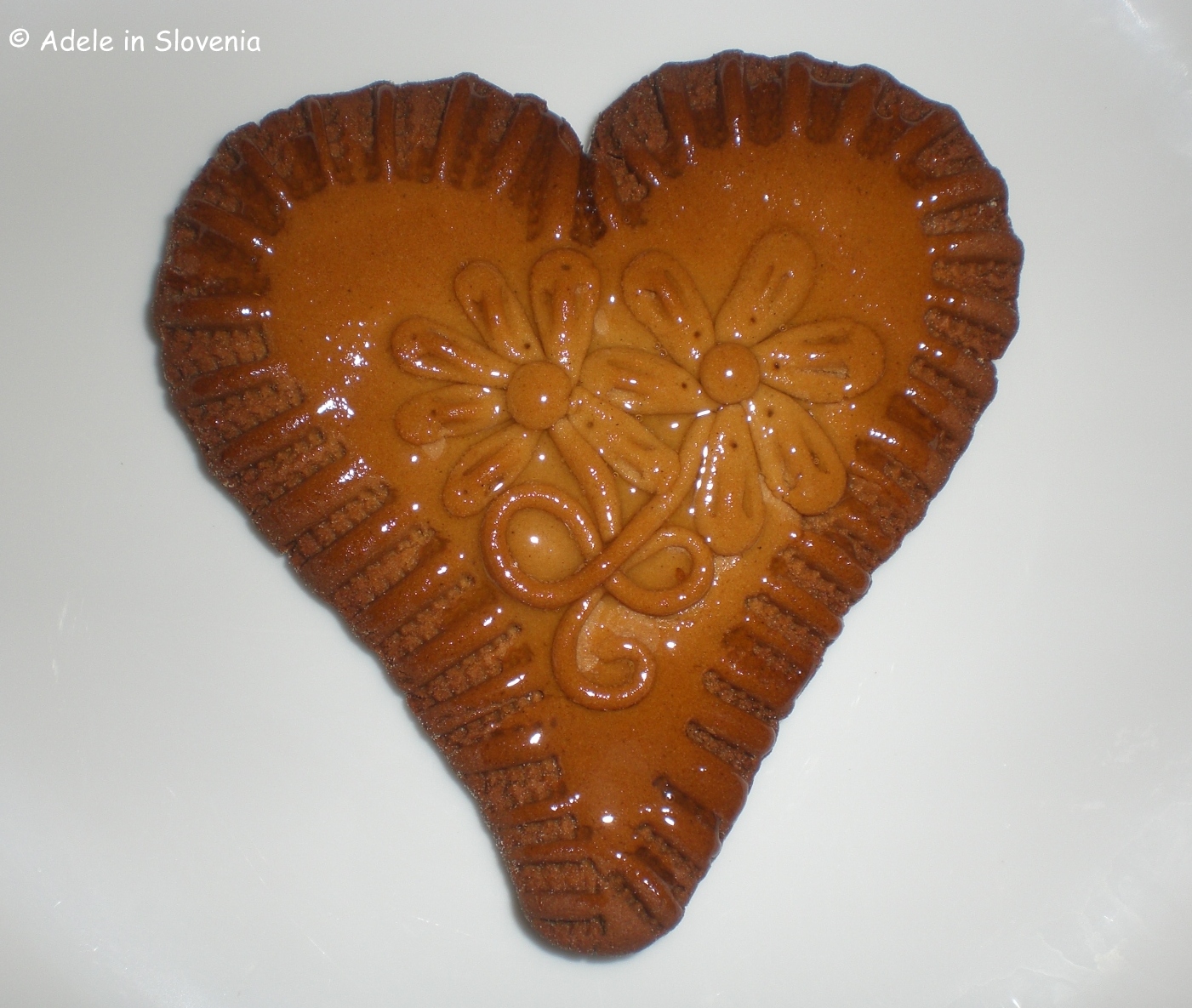
Don’t miss a visit to Lectar Inn where you can try traditional Slovenian food and downstairs visit the workshop with it’s 250-year tradition of making red-iced and decorated gingerbread hearts.

The Lectar gingerbread workshop

Radovljica also offers a wealth of great places to stroll, hike, cycle, do water sports, or partake in other active or less active pursuits. Or you can just sit on one of the benches at the viewing area and and soak up the views of the Julian Alps, the Jelovica Plateau and the Sava River.

Looking back at the old town with majestic Mr. Stol in the background

And be sure to come hungry as you won’t want to miss the chance to taste some of the delicious locally-produced food at the 13 restaurants that collaborate in the Taste Radol’ca project.

In addition to Radovljica , there are a further 13 towns and cities included in the Association of Historical Towns and Cities of Slovenia – Idrija, Kamnik, Koper, Kostanjevica na Krki, Kranj, Metlika, Novo Mesto, Piran, Ptuj, Slovenske Konjice, Škofja Loka, Tržič and Žužemberk.

More information about Radovljica can be found here – http://www.radolca.si/en/radovljica-area/ and more about the association here – http://www.zgodovinska-mesta.si/eng/index.php

© Adele in Slovenia
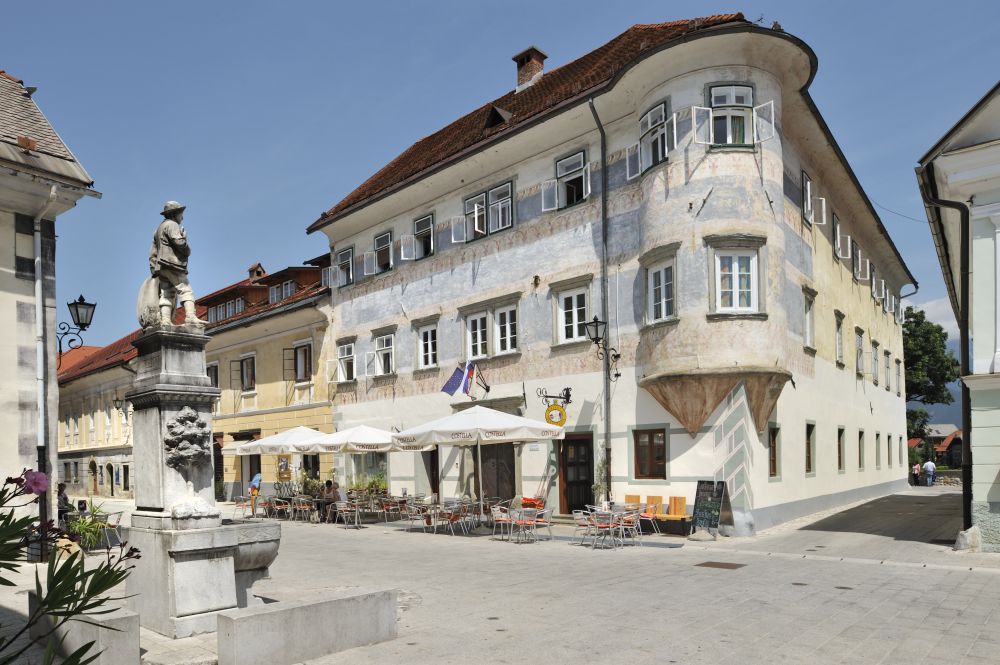
 

Bears, Bread and Bukovec in the Poljane Valley

To get the full flavour of the pristine Poljane valley it’s necessary to take your time to explore the area, seek out some of its more hidden parts, soak up the best vistas, visit remote farms, try the tastiest home-produced food and drink, walk its forests and paths, and meet some of the friendly locals – including the bears (read on!). I recommend doing all of this is on a walk on the Path Through Zala (Pot skozi Zalo).

The Path Through Zala theme path runs mostly through the forest in Zala and begins at the Pr’ Bukovcu farmstead (shown as Bukovec on the map), which is located in Žirovski Vrh, high above the Poljane valley. The original farmhouse, Bukovčeva hišadates back to 1639.

Nowadays the farm is a popular place for walkers to stop for refreshments (it’s advisable to call ahead to book, but if you’re passing they can always ‘rustle something up’ if needs be!) and/or to buy a few provisions for along the way or to take home, such as dried fruit, baked goods, milk and schnapps – all of them home-produced and organic. One of the farm’s outbuildings also has an area ideal for group picnics or other such social events.

On Sundays you won’t be able to pass the farmhouse without being lured in by the aroma of freshly-baked bread. In fact, the farm’s bread has become quite legendary and attracts people from far and wide!

The first and last section of the 11km path run along the ridge of Žirovski Vrh, from where, on a clear day, there are panoramic views of all 3 of Slovenia’s mountain ranges – the Julian Alps, the Karavanke, the Kamnik-Savinja Alps – as well as across the valleys below.

Literally everywhere you look there are jaw-dropping views!

If you haven’t got time to walk the entire path, you should at least walk the 3.5km Bear Cub Path (Medvedkova pot), which begins opposite the Pr’ Bukovcu farm. The Slovene writer Dr. Ivan Tavčar wrote a book about Zala, telling the story of Canon Amandus who shot a bear that attacked and severly wounded him in Zala. You can find out more about how the story unfolds on the Path Through Zala.

The Bear Cub Path is marked with yellow paw prints on trees and equipped with 7 boards showing 7 themed games, ensuring the little ones won’t be bored!

The circular path is suitable for all and is easy trail, however, sensible footwear is required as it crosses a stream and traverses undulating forest paths.

The highlight of the path is the 3.5 metre-high bear, Štefka, and bear cub, both made from moss. What a great thing to find in the middle of the forest and there’s no doubt you will want to get ‘up close and personal’ with these bears!

If you walk the longer route of the Path Through Zala, you will also pass some of the many fortifications and bunkers of the Rupnik Line on Goli vrh, built in the 1930’s by the then Kingdom of Yugoslavia as a defence line on the border with the Kingdom of Italy (more about this to come in a future blog!).

Other highlights of the 11km path include the Mrakov grič and Selakov grič viewpoints, the Pr’ Mrak, Pr’ Šimc and Pr’ Omejčk farmsteads, the Hunter’s Lodge, and the Zala stream.

Every year the Žirovski Vrh Tourist Association organises guided walks on the Path Through Zala. This next walk will be held on 2nd May. More information here (in Slovene) – http://www.tdzirovskivrh.si/.

Photo: TD Žirovski vrh

More information about this and other theme paths in the Škofja Loka area can be found on the Visit Škofja Loka website – http://www.visitskofjaloka.si/en/experiences/theme-paths and more about the Pr’ Bukovcu farmstead here (in Slovene only) – http://www.bukovc.si/

© Adele in Slovenia
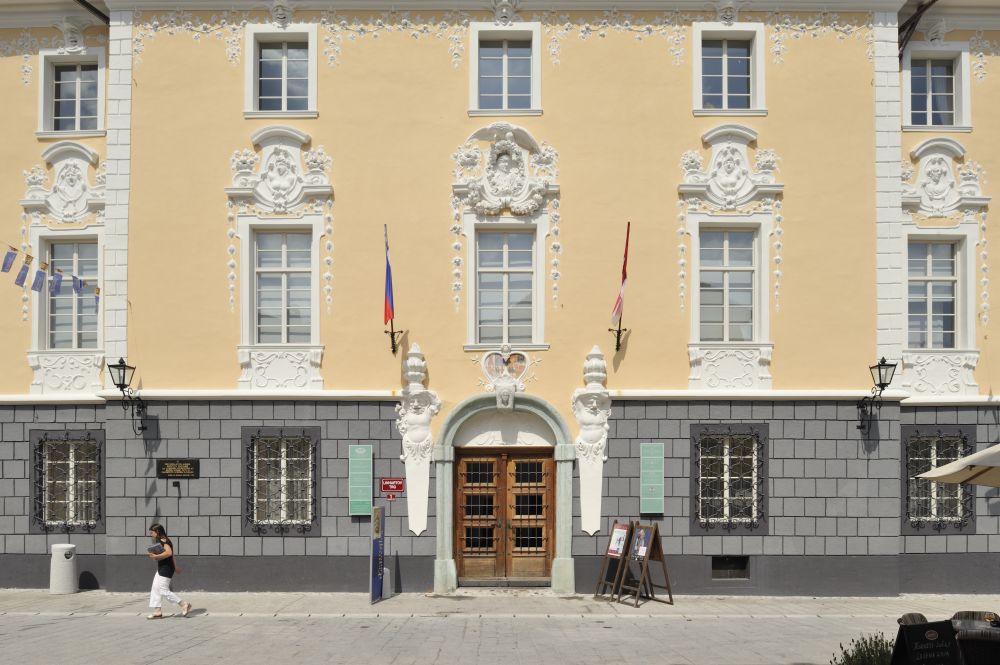


Beguiling Begunje na Gorenjskem

I’m fortunate to live just a few kilometres from the village of Begunje na Gorenjskem, which is packed full of natural and cultural sights of interest. I spend quite a lot of time there, too, whether hiking, cycling or eating great Taste Radol’ca food. So, in this blog I’ve focused on some of the highlights of beguiling Begunje.

Fans of popular folk music won’t want to miss a visit to the Avsenik family homestead, where the legendary forefathers of Slovene folk music, Slavko and Vilko Avsenik were born. Though, sadly, Slavko passed away in 2015, the family’s music very much lives on.

You can visit the gallery and museum, and/or attend one of the frequent music evenings and other events. More information here – http://www.radolca.si/en/avsenik-gallery-museum/

The Katzenstein Mansion in the heart of the village has had a long and interesting past. Built in the 14th century, its current Renaissance and Baroque appearance is a result of renovations in the 16th, 17th and 18th centuries. 1n 1875 the mansion was sold to Austro-Hungarian judicial authorities and a prison, holding 300 female prisoners, was established. During the German occupation, it became a Gestapo prison and political prisoners were incarcerated in the mansion; after the war it again reprised its role as an all-female prison.

The Museum of Hostages (Muzej Talcev) has been housed in the building at the north-western end of the residential wing since 1961. Inside, on the walls of the former prison cells, you can see written records left by the prisoners and announcements by the occupiers concerning executions. This one says ‘Molimo za mir’ (We pray for peace). Sobering stuff, indeed.

The park in the ground of the mansion is a lovely place for a stroll. It contains a pavilion and the Chapel of St. Joseph, designed by the most famous Slovenian architect, Jože Plečnik, and is also home to a small cemetery where 457 hostages and 18 World War II combatants are laid to rest. The bronze statues of a hostage and a prisoner, as well as the karst marble sculpture of a female hostage are the work of the sculptor, Boris Kalin.

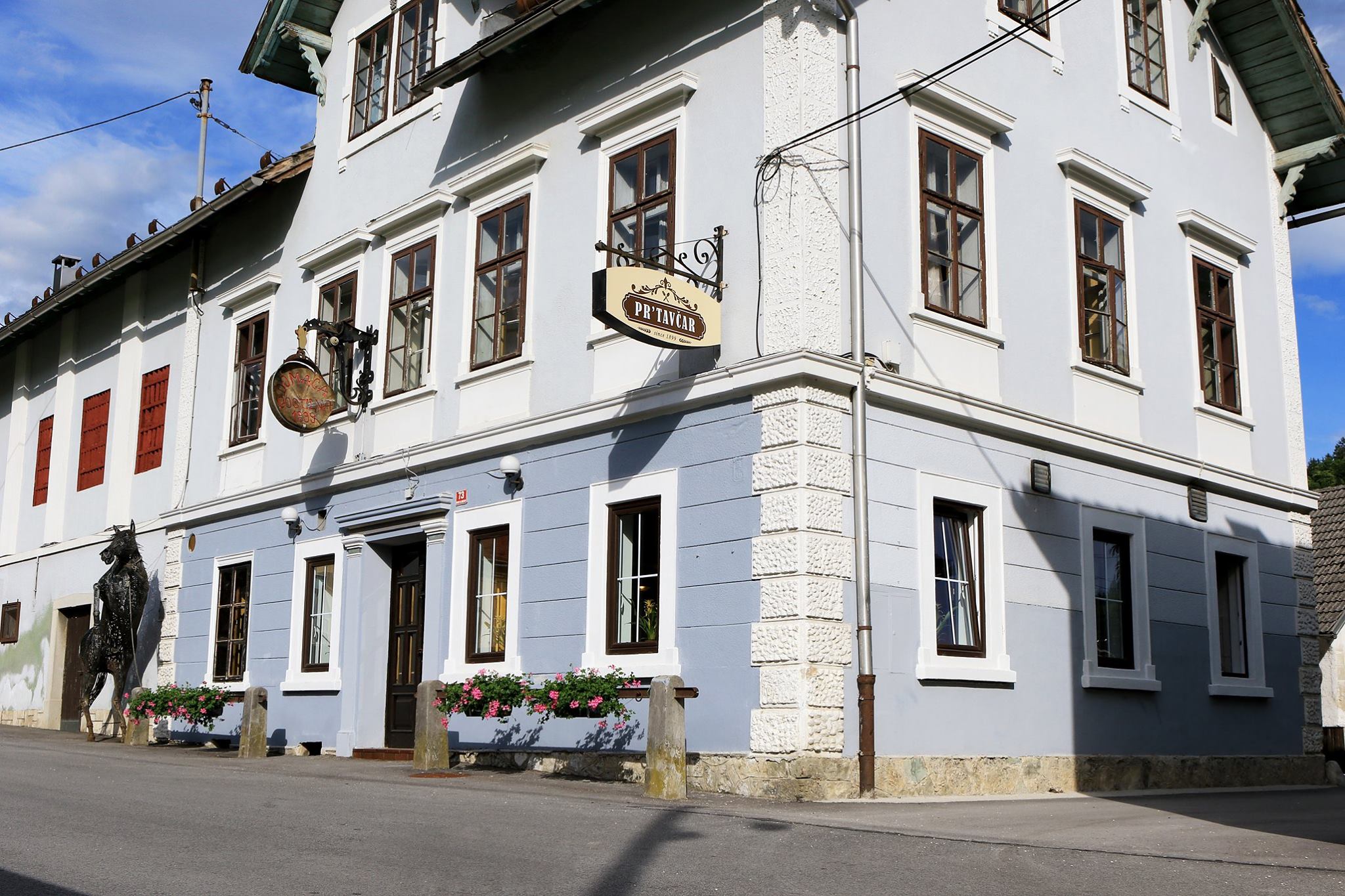
Also in the heart of the village, near the entrance to the hospital and park, is the Gostilna Pr’ Tavčar restaurant, one of the 13 Taste Radol’ca restaurants. In the relatively short time it has been open it has become a firm favourite among locals.

At the end of the village you reach the Draga valley and the imposing ruins of  Kamen Castle, built in the 12th century by the Counts of Ortenburg. More information here – http://www.radolca.si/en/kamen-castle/

Photo: M Kambic

The short drive to the end of the valley brings you to Gostišče Draga, another of the participating Taste Radol’ca restaurants, where specialities include venison goulash, fresh trout, homemade sweet and savoury štruklji, and more. Situated in the shade of the forest beside a stream, it is particularly popular with those seeking refreshment and sustenance after expending their energy in the surrounds.

The Draga valley is a gateway for numerous hiking trails in the Karavanke mountains including, amongst others, to Begunščica, the ever-popular Roblekov dom mountain hut, and the Preval mountain hut.

As you can see, despite it’s modest size, Begunje packs in a lot, so be sure to include a visit on your trip to the Radovljica area.

© Adele in Slovenia
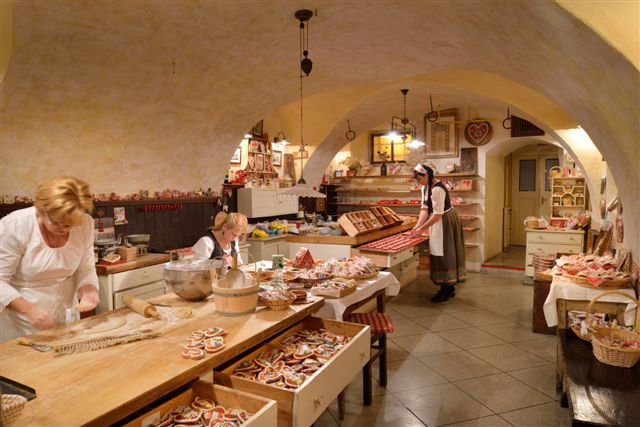
 

Delightful Dražgoše: The Home of Dražgoše Honey Breads and Serious Sunshine!

The village of Dražgoše is nestled into the southern slopes of the Jelovica plateau, perched at an altitude of 832m above sea-level, above the Selca valley and the town of Železniki. Thanks to its favourable location, Dražgoše is renowned as being one of the sunniest villages around and proudly goes under the slogan ‘Pri nas sonce je doma’ (Here is where the sun is at home).

dsc00440

Dražgoše is most known for 2 things – its intricate hand-crafted honey breads and the Battle of Dražgoše. A good place to start a visit and learn more is at the recently reopened Brunarica Dražgoše snack bar.

47966_448360748432_2879696_n

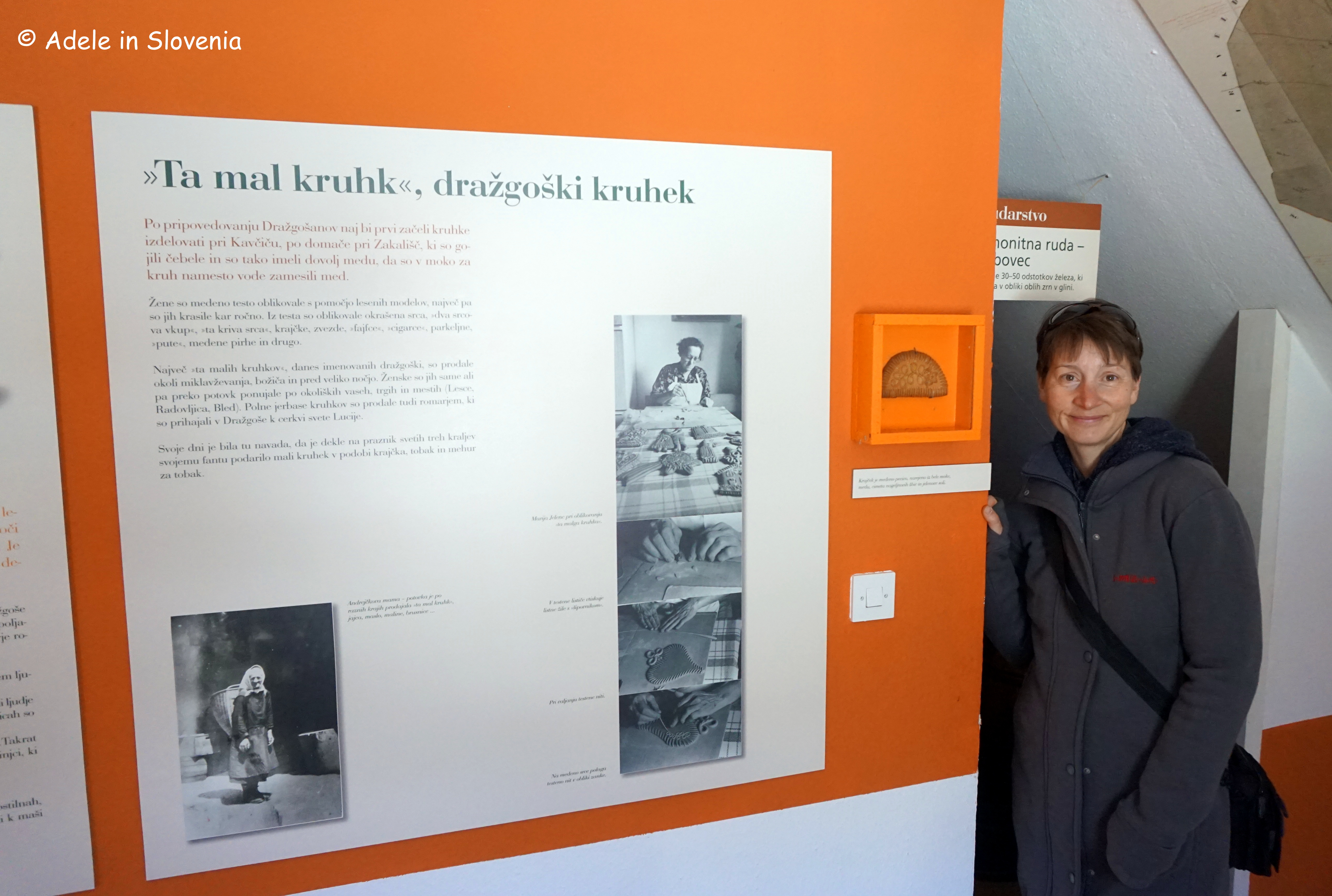
In addition to hot and cold drinks and snacks, you can pop upstairs to the small museum for a brief introduction to the history of the village and the tradition of making honey breads.

dsc00434

There are 2 types of honey breads made in the Škofja Loka regionLoka honey breads (which regular readers will recall I recently made at the DUO Centre in Škofja Loka, read more here – https://adeleinslovenia.com/2017/01/13/loka-honey-breads-and-handicrafts-at-the-duo-arts-crafts-centre/) and Dražgoše honey breads. The key difference between the two is that Loka honey breads are made using a hand-carved mould, whereas Dražgoše honey breads are made entirely by hand.

I visited Breda Tolar and Alenka Lotrič who are masters in the art of making Dražgoše honey breads and are continuing their grandmother’s tradition.

dsc00443

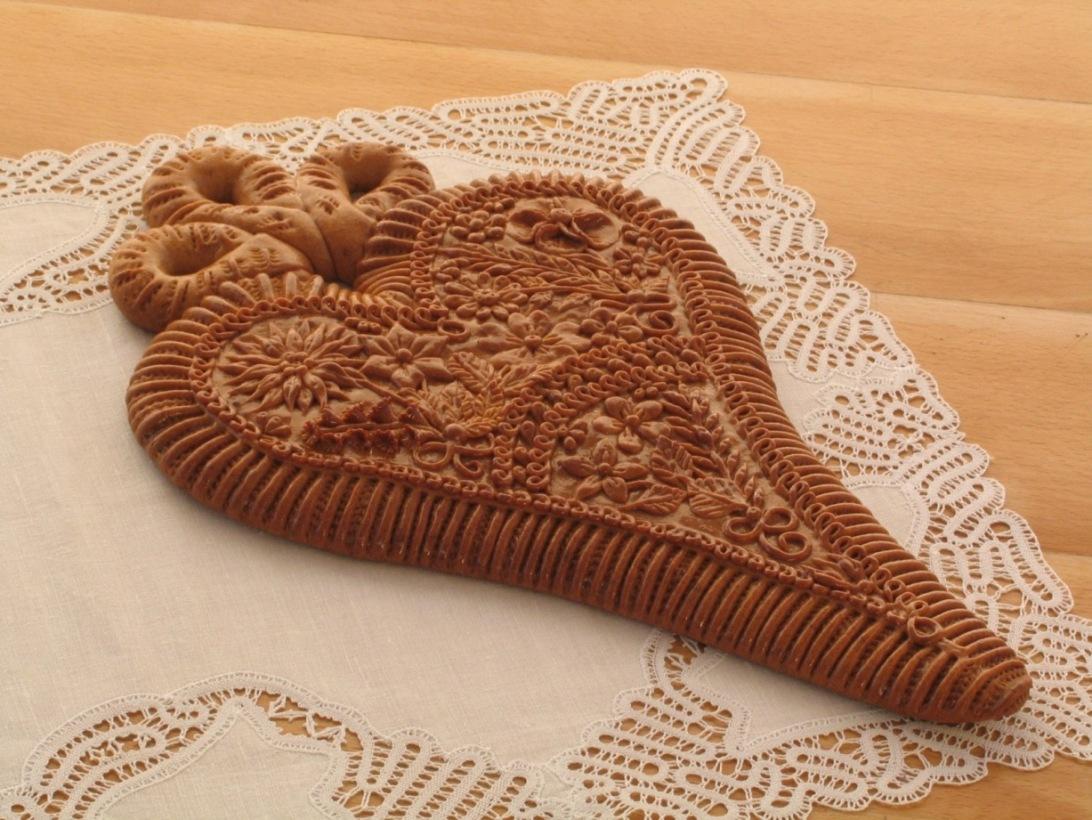
The dough is made using flour, honey, cinnamon and cloves. The honey is warmed through before mixing to allow the dough to be pliable for rolling and shaping.  Some of the designs are highly intricate and labour-intensive – real works of art. Dražgoše honey breads are edible, though in cases such as this one below, it would be such a shame to do so!

slika_jpg

Whilst I haven’t been blessed with any form of artistic talent whatsoever, these two ‘pros’ made it look easy. Just look closely at their versions compared to mine!

dsc00461

After the intricate patterns are finished, the breads are baked in the oven then glazed with (more!) honey for a shiny finish. All couples getting married at Loka Castle (read more here – https://adeleinslovenia.com/2017/01/01/a-spotlight-on-skofja-loka/) receive a honey bread as a wedding gift. You can be sure that it will look better than my finished effort, though its not too bad for a novice I suppose, and I sure had fun making it, which is what counts!

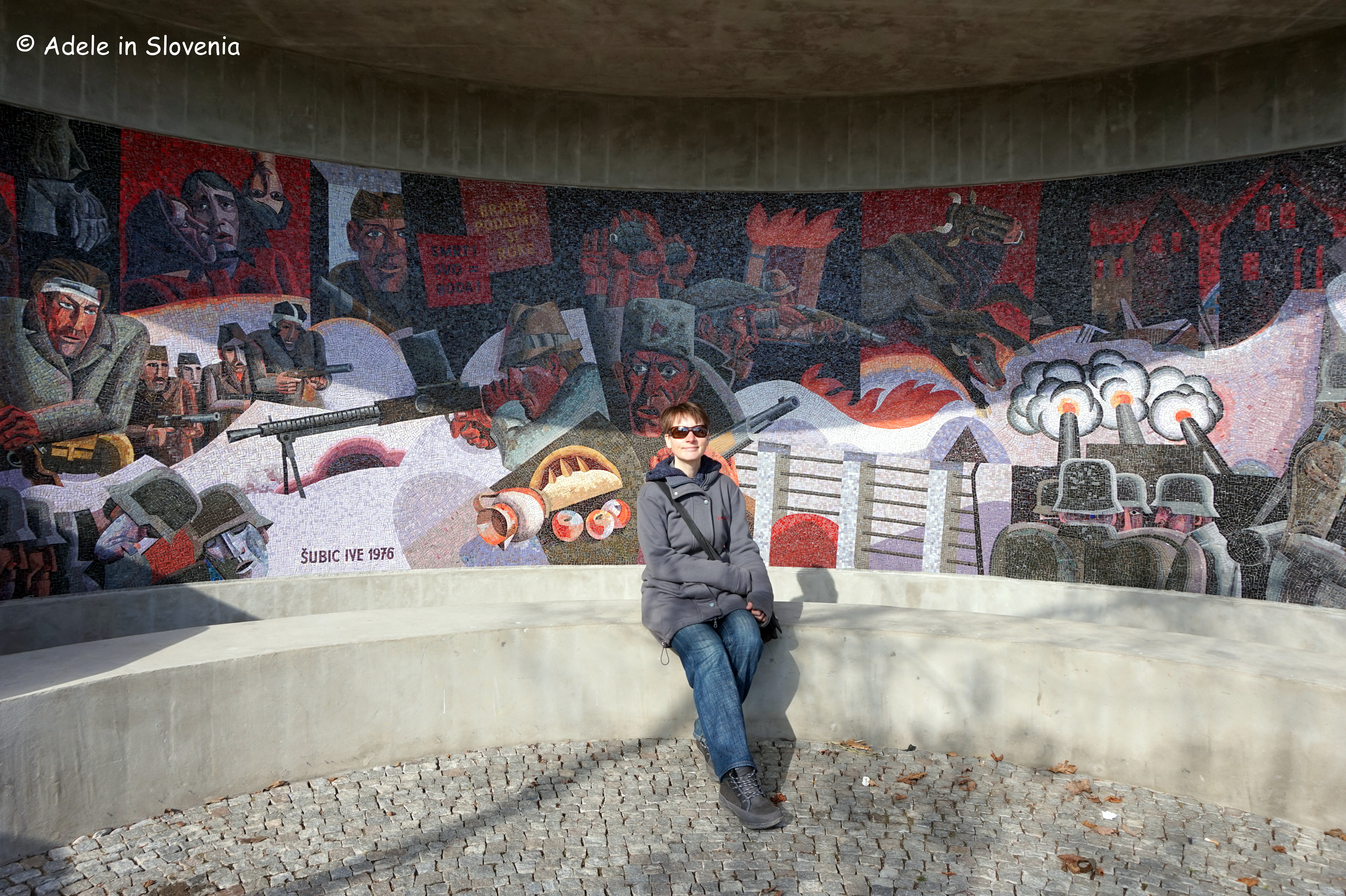
The monument to the Battle of Dražgoše commemorates the World War II battle between Slovenian Partisans and Nazi armed forces, which ended with brutal reprisals by the German forces – executions, looting and torching of buildings – and the destruction of the village. The village was entirely rebuilt after the war. The monument with an ossuary was erected in 1976.

dsc00439

spomenik3_jpg

The painting is by the renowned painter Ive Šubic from nearby Hotavlja who participated in the battle as a Partisan, later returning to depict it in art.

dsc00437

Though the old village church was destroyed in the battle, the Škofja Loka Museum Association was able to move the partly-preserved altars to where they stand today in the chapel of Loka Castle, whilst the original church organs are now in the church in Železniki. In the village you can still see the remains of the church which have been well-preserved and where there is a memorial park.

stara-cerkev

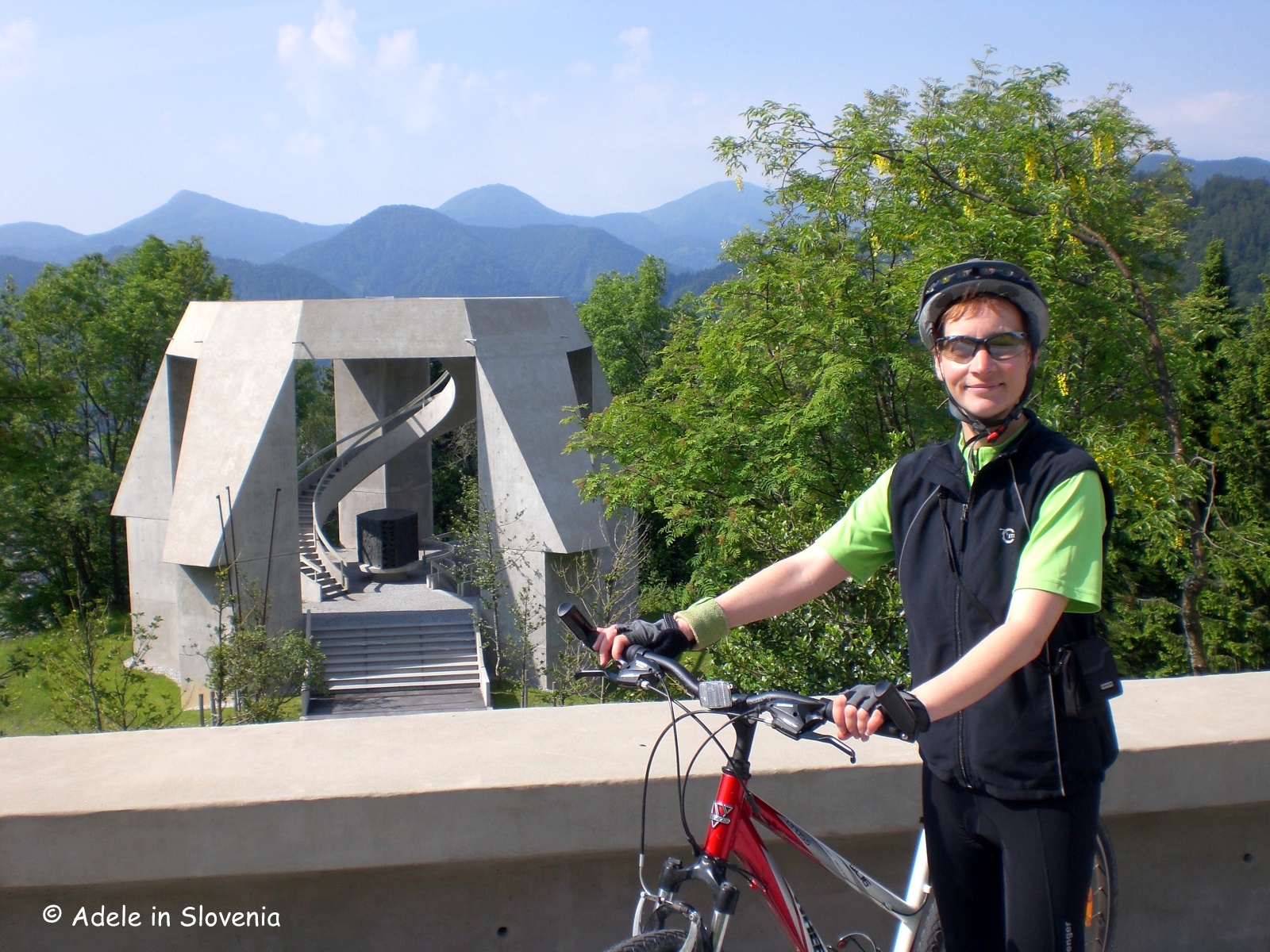
Dražgoše is also an idyllic area for hiking and cycling, albeit, flat it isn’t! In summer I’ve been known to cycle up from home in Radovljica first to Kropa, up to Jamnik and then on to Dražgoše. On this occasion (below), I was feeling particularly energetic and continued down into the Selca valley to Škofja Loka then via Kranj back to Radovljica. It was a long tiring tour but one that I must do again some time!

You can also hike up above the village to the hilltop of Dražgoška gora, visit one of a number of caves (accompanied by a guide), talke a walk along all, or part of, the Spominska pot (the Memorial Path) – a 3-3.5 hour-long route beginning at the Brunarica snack bar.

For more information about any of the above, and/or to arrange a honey bread workshop, contact Visit Škofja Lokahttp://www.visitskofjaloka.si/en/

© Adele in Slovenia
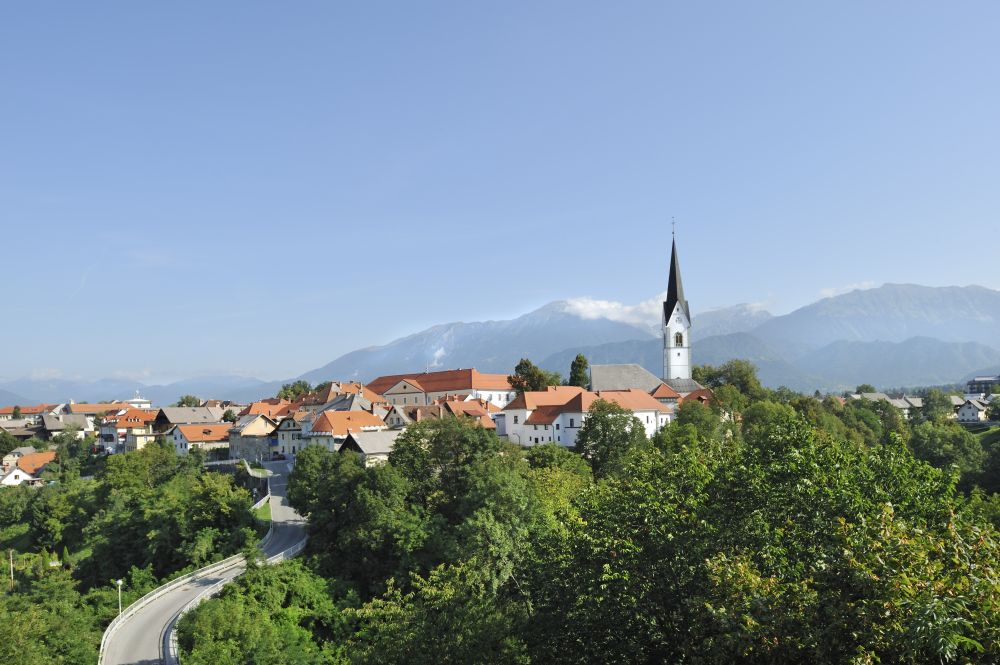
Spring in Radovljica Means Chocolate!

Yes, finally, after the coldest winter for over 30 years, spring is finally springing here in the Radovljica plains. And spring in Radovljica has come to mean chocolate, chocolate and more chocolate, due to the now annual Radovljica Chocolate Festival – this year taking place from Friday 21st – Sunday 23 April. How lucky I am that it takes place in my home town!

Though summer will always be my favourite season, spring isn’t far behind as it’s a time of blooming flowers, Easter, new-born lambs, longer days, warmer temperatures and, in case I haven’t already mentioned it, chocolate!

pomlad-3-3-2017

Photo: Adele in Slovenia

To whet you appetite, and in case you missed it, here’s a recap of some of last year’s festival fun!

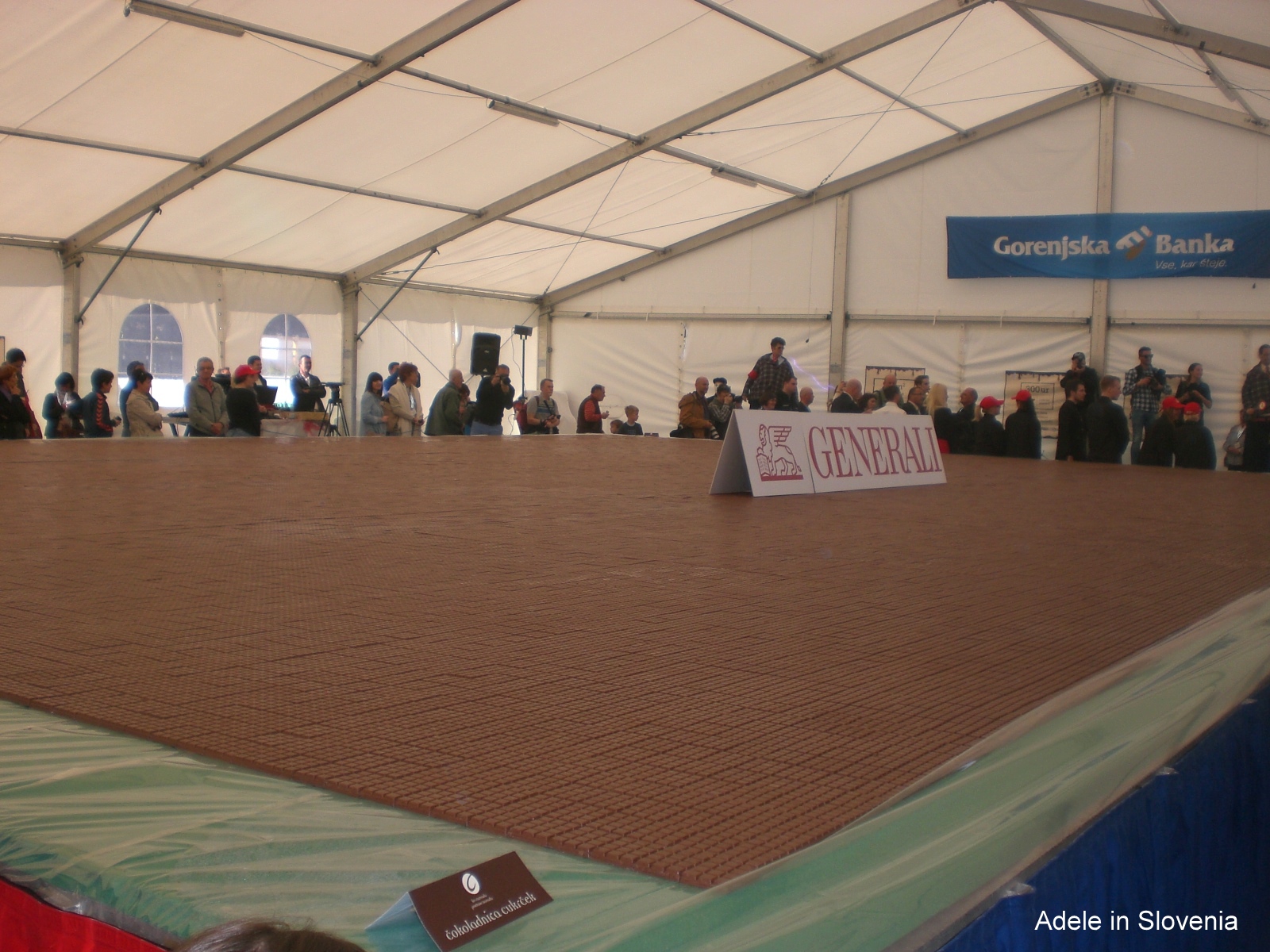
Guinness record was broken for the world’s largest chocolate bar by area. The chocolate bar was made by the Cukrček chocolatier and measured over 140 square metres, smashing the previous record of 102 square metres. It took over 300 hours to piece together the 28,000 pieces of chocolate.

cimg0851

There was also a record number of chocolatiers and visitors to last year’s festival, and I have a feeling that this year, the 6th Radovljica Chocolate Festival, could be even bigger and better.

13041065_1077943002248915_5048165062827836274_o

Photo: Aleš Košir

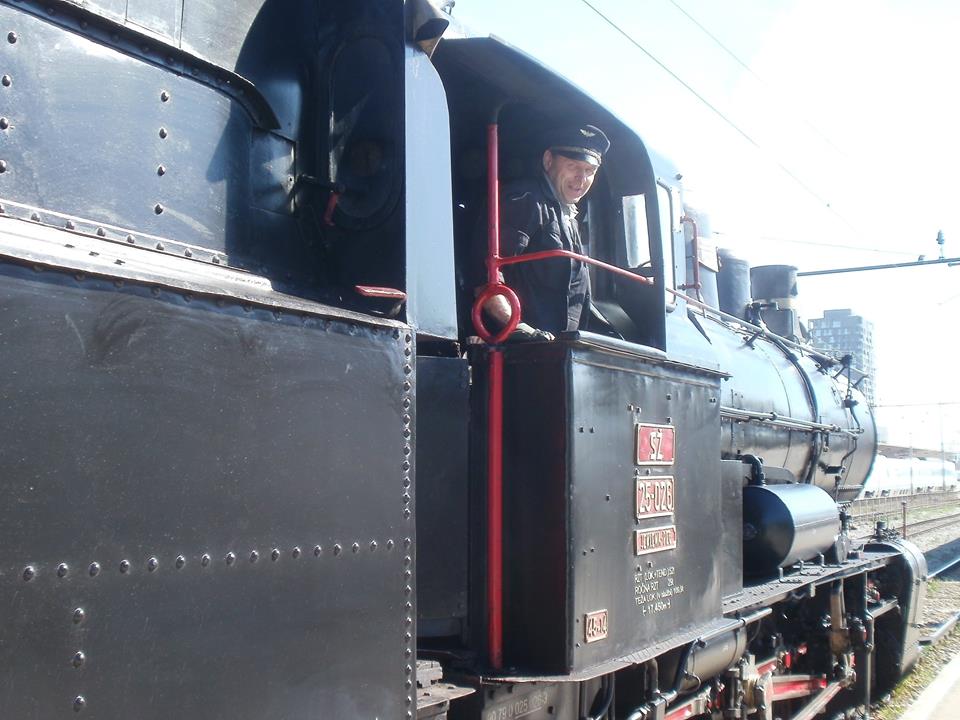
For the first time last year visitors were able to travel to/from the festival by vintage steam train from Ljubljana.

12991053_1352567444758593_7081727616073599369_n

Photo: Adele in Slovenia

The packed programme also includes chocolate-related entertainment for all the family.

13041252_1077943135582235_4488269117016114694_o

Photo: Aleš Košir

What will this year’s festival bring? Well, the 2017 festival programme is still being prepared, but it will be available soon so keep your eye out on the festival website for updates – http://www.festival-cokolade.si/festival-2017/ as well as on the Visit Radol’ca Facebook pagehttps://www.facebook.com/RadolcaHonestlySweet/

© Adele in Slovenia


A Feast of Flavourful Fondues at Vila Podvin

Thanks to the ever-creative team at Vila Podvin in Mošnje, now there’s no need to go all the way to the Swiss Alps to enjoy a cheese fondue! Though only recently revived, the tradition of fondues in Podvin actually dates back quite some way.

cimg2883

Prior to World War II, the French Duke of Polignac lived in Podvin Castle and, according to locals, the castle’s residents used to enjoy fondues on cold winter evenings, made with cheese that they brought with them from France. Vila Podvin decided to revive the tradition this winter, initially just for the month of February, but it’s been such a hit, that you will now be able to enjoy a fondue up until the end of April!

cimg2889

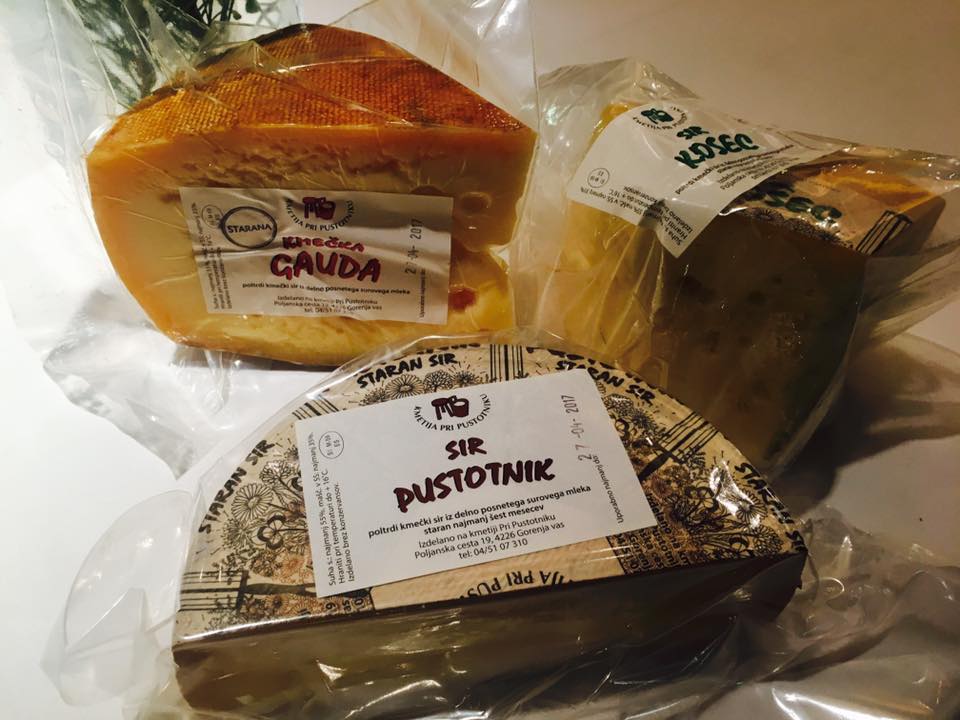
When creating and testing fondue recipes, Uroš Štefelin, co-owner of Vila Podvin and one of Slovenia’s top chefs, was keen to ensure that rather than using imported cheese, he uses the excellent-quality cheese that is produced here in Slovenia. And he knew just where to turn – the  award-winning Pustotnik dairy from Gorenja vas – with whom he set about blending a mixture of their cheeses to create the perfect fondue.

16387985_1371325429607940_3553358564201552740_n

You can also try and buy Pustotnik cheese at the monthly Vila Podvin Local Market, which takes place on the first Saturday morning of each month. Read more here – https://adeleinslovenia.com/2016/09/05/shop-locally-at-radovljicas-farmers-and-craft-markets/

Vila podvin trznica

Each cheese fondue comes with a whole host of tasty and unusual bite-size delights to dip into the gooey cheese!

cimg2886

For a change from dining alone (sigh!), I invited fellow blogger Peter, who writes a blog in German about Slovenia, to join me for dinner – especially since the fondues are designed for two. Of course, fondues are not restricted to just cheese, oh no, lucky for me Vila Podvin does a chocolate fondue too, using 60% dark chocolate and with a range of wonderfully sinful things to dip, including chocolate brownies, fresh and dried fruit, macarons …

cimg2897

Another important feature of the fondues, as well as other dishes, is the recent link-up with attendees of the Radovljica Centre for Work, Training and Care (CUDV). Working together they have created unique pieces of ceramicware on which to serve up the restaurant’s tasty and creative dishes. The range of products is collectively made and sold under the name BISER, meaning ‘pearl’, and they really do make original gifts or additions to your own kitchenware.

16473325_1371325346274615_8740353106975067474_n

Find out more about Vila Podvin here – http://www.vilapodvin.si/EN/ and about Taste Radol’ca here – http://www.radolca.si/en/taste-radolca/

© Adele in Slovenia

Sorica: Super Skiing and Slovenia’s Most Beautiful Mountain Village

The well-kept village of Sorica is considered to be one of most beautiful mountain villages in Slovenia. As the tourism writer Rudolf Badjura wrote ‘It would be necessary to travel some distance around the world to see such a beautiful village.’ And even though it didn’t look its best on a slightly overcast February afternoon when I visited, when nature’s hues are still somewhat subdued after the winter slumber, one can easily imagine how glorious it must be here in the warmer months when nature is at its vibrant best.

dsc00362

Sorica is known as Grohar’s village (Groharjeva vas) as it is the birthplace of one of Slovenia’s most esteemed impressionist painters, Ivan Grohar (1867-1911).

dsc00360

The best way to get acquainted with the village is by walking the theme path ‘Path through Sorica’, which begins in the centre of the village between the Gostilna Macesen restaurant with rooms and Grohar’s House (Groharjeva hiša) – Ivan Grohar’s birth house.

dsc00365

With views like this, it’s easy to see where Grohar got his inspiration! The 18th century Baroque parish church of St. Nicholas contains a ceiling fresco of ‘The Last Supper’ by another of Slovenia’s esteemed painters, Janez Šubic from Poljane.

Tone Logonder, the sculptor of the statue of Ivan Grohar which was placed here in 1981, received the Gorenjska Prešeren Award for his work.

dsc00371

Rather than just being a museum, locals wanted Grohar’s House to once again come to life and a winning formula was found in making it into a kind of one-stop cultural centre which has become particularly popular for school field trips, and visits for private groups can also be arranged. The ground floor features a gallery.

dsc00380

On the first floor you can indulge your creative side and take part in a workshop in the music room.

dsc00389

And then head up to the upper floor to the artists’ workshop to have a go at creating one of your own pictures to rival that of Grohar!

dsc00391

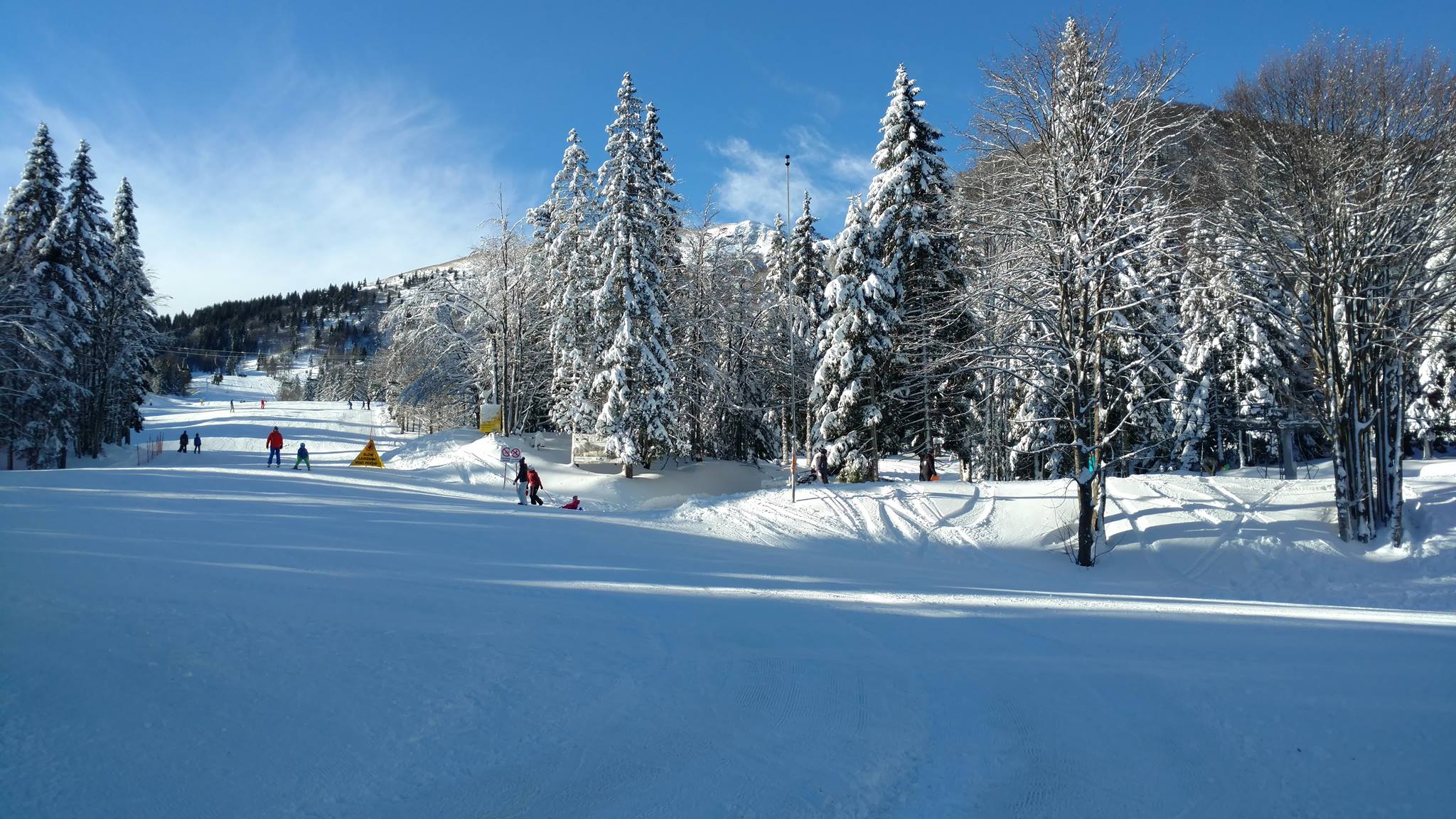
You can choose to just soak up the views of the village and its surroundings, set off on one of the many paths in the hills and mountains or, for those with a thirst for more active pursuits, head up to Soriška planina where in winter you can ski and in summer there are numerous scenic and interesting hiking trails.

dsc00334

Soriska planina can be reached from several directions; from Škofja Loka via Železniki, from Bohinjska Bistrica or from Most na Soči via Baška Grapa.

dsc00356

Facilities at the Soriška planina ski resort consist of a two-person chairlift, 3 drag lifts, a children’s drag lift, a snow park, a sledging track, cross-country ski trails and a restaurant.

15975001_1301471476588056_8741942859265004115_o

I had previously hiked in this area in the summer, but prior to last week had never seen it in its winter glory. Even for non-skiers like me, there’s still snowy fun to be had! Here I am at the highest point of the ski resort looking back down over the village of Sorica.

dsc00344

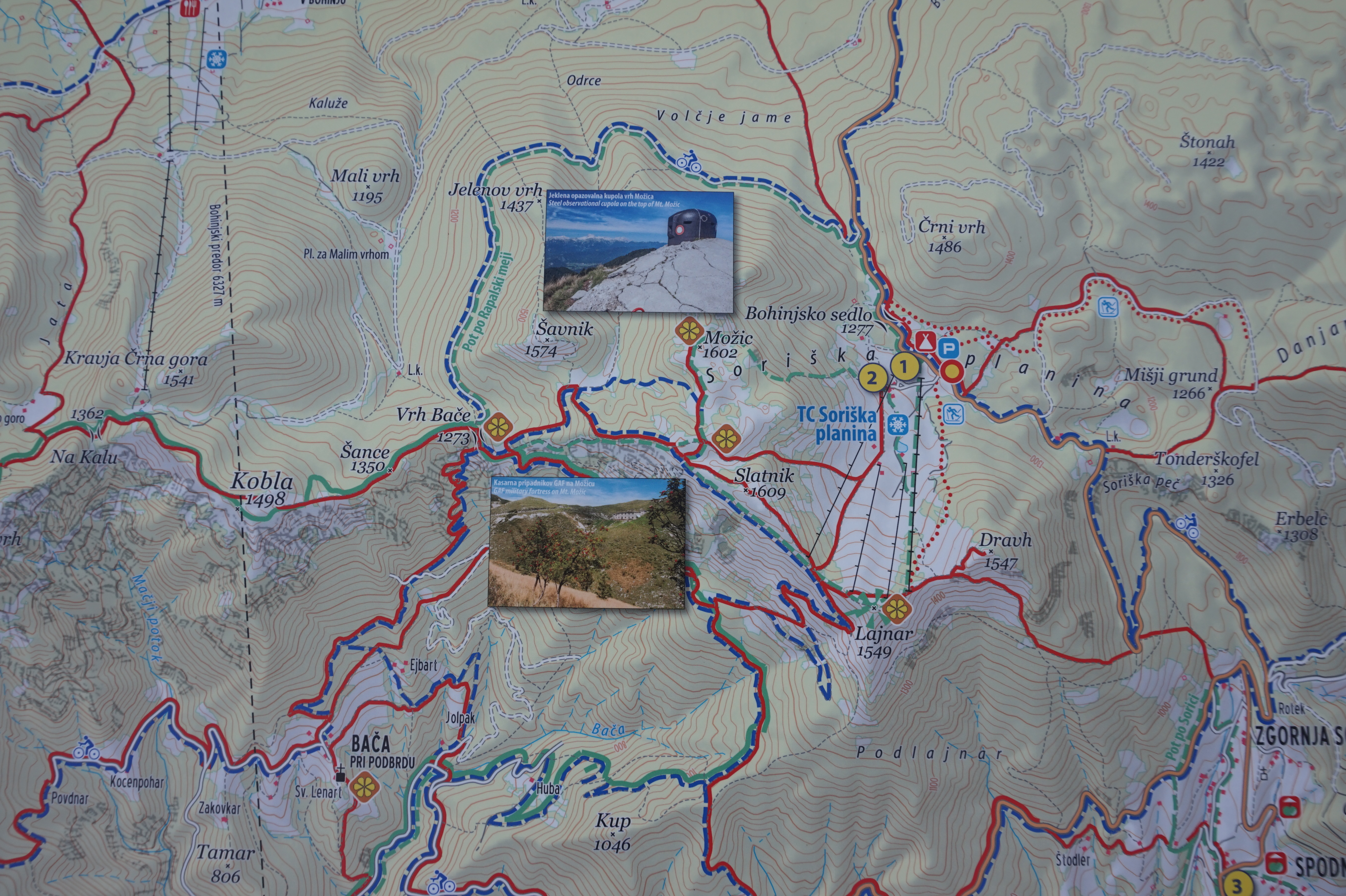
One of the most interesting features of this area are the numerous bunkers, barracks and other fortifications remaining from the time of the Rapallo Border – a former border that existed during both world wars between Yugoslavia and Italy.

Below you can see the bunker on Lajnar, and you can also continue to others including on Možic, Slatnik and Dravh.

dsc00346

Find out more about the Soriška planina ski resort here – http://www.soriska-planina.si/en/hiking/ and more about other theme paths and trails along the Rapallo Border here – http://www.visitskofjaloka.si/en/experiences/theme-paths/rappalo-border

© Adele in Slovenia